How to Prepare for UPSC with NCERT
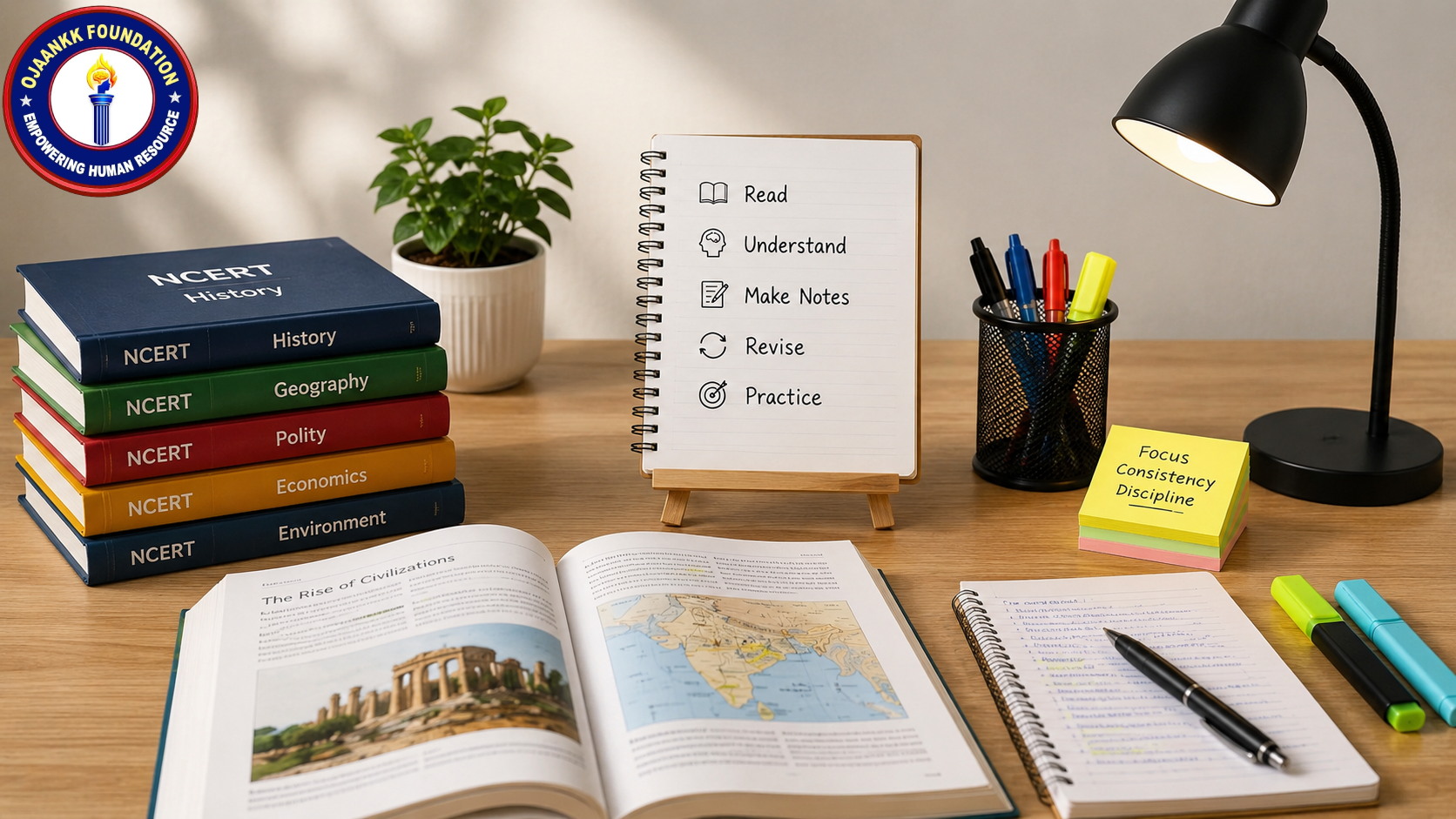
How to Prepare for UPSC with NCERT: Complete NCERT Strategy for Beginners
NCERT books are considered the backbone of UPSC Civil Services Examination preparation. Almost every UPSC topper recommends reading NCERTs because they help aspirants build strong fundamentals, conceptual clarity, and analytical understanding.
For beginners, NCERT books are the best starting point for UPSC preparation. They provide simple explanations of complex topics and help aspirants develop a solid base for both Prelims and Mains.
If you are confused about how to study NCERT for UPSC, which NCERTs to read, and how to make notes from NCERTs, this complete guide will help you create an effective NCERT strategy for UPSC preparation.
Why are NCERT Books Important for UPSC?
NCERT books are important because they:
- Build strong conceptual clarity
- Explain topics in simple language
- Cover the static portion of the UPSC syllabus
- Help in both Prelims and Mains
- Improve answer writing quality
- Strengthen analytical thinking
- Help in understanding advanced standard books
Many UPSC questions are directly or indirectly based on NCERT concepts.
Should Beginners Start UPSC Preparation with NCERT?
Yes, absolutely.
NCERT books are the best starting point for beginners because:
- They are easy to understand.
- They explain fundamentals clearly.
- They help build a strong foundation before advanced books.
Without proper NCERT preparation, advanced UPSC books may become difficult to understand.
Which NCERT Books Should You Read for UPSC?
Not every NCERT book is equally important. Aspirants should focus on selected subjects relevant to UPSC.
Subject-Wise NCERT List for UPSC
| Subject | Recommended NCERT Classes |
|---|---|
| History | Class 6–12 |
| Geography | Class 6–12 |
| Polity | Class 9–12 |
| Economics | Class 9–12 |
| Science | Class 6–10 |
| Sociology | Class 11–12 |
| Art & Culture | Fine Arts NCERT Class 11 |
Step-by-Step NCERT Strategy for UPSC
1. Understand the UPSC Syllabus First
Before reading NCERTs, carefully go through the UPSC syllabus.
This helps you:
- Read selectively
- Avoid unnecessary topics
- Stay focused on exam-relevant areas
Always connect NCERT topics with the UPSC syllabus.
2. Start with Basic Subjects
Begin with easy and foundational subjects such as:
- Geography
- History
- Polity
- Economics
Avoid reading too many subjects simultaneously.
3. Read NCERTs in Chronological Order
Read NCERTs class-wise from lower to higher levels.
Example for Geography
- Class 6 Geography
- Class 7 Geography
- Class 8 Geography
- Continue till Class 12
This approach develops gradual conceptual understanding.
4. Focus on Conceptual Clarity
Do not memorize everything blindly.
Instead, focus on understanding:
- Concepts
- Cause-effect relationships
- Processes
- Interlinkages
UPSC tests analytical understanding rather than rote learning.
5. Make Short Notes from NCERTs
Note-making is extremely important.
Your notes should include:
- Important facts
- Definitions
- Dates
- Examples
- Maps
- Diagrams
- Government-related concepts
Short notes help during revision before the exam.
6. Highlight Important Topics
While reading NCERTs:
- Underline important lines
- Highlight keywords
- Mark important examples
- Identify UPSC-relevant portions
This improves revision efficiency.
7. Solve Previous Year Questions (PYQs)
After completing NCERTs, solve UPSC Previous Year Questions.
This helps you understand:
- How UPSC asks questions
- Important topics
- Frequently repeated concepts
- Difficulty level
PYQs help in linking theory with exam application.
8. Revise NCERTs Multiple Times
Revision is the key to UPSC preparation.
One reading is never enough.
Ideal Revision Strategy
- First Reading → Understanding
- Second Reading → Note-making
- Third Reading → Revision & PYQs
Multiple revisions improve retention.
Best Subjects to Prepare with NCERT
1. History
NCERTs are extremely important for:
- Ancient History
- Medieval History
- Modern History
- Art & Culture
History NCERTs help build chronological understanding.
2. Geography
Geography NCERTs are among the most important books for UPSC.
Focus on:
- Physical Geography
- Indian Geography
- Human Geography
- Environment basics
Practice maps regularly.
3. Economics
Economics NCERTs simplify concepts like:
- GDP
- Inflation
- Banking
- Budget
- Fiscal policy
These basics are important for both Prelims and Mains.
4. Polity
Political Science NCERTs help understand:
- Constitution
- Democracy
- Rights
- Governance
- International relations
They build the foundation before reading advanced books like Laxmikanth.
5. Sociology
Sociology NCERTs are useful for:
- Society-related topics
- Essay writing
- Ethics
- GS Paper I
Common Mistakes While Studying NCERTs
1. Reading Without Syllabus
Always study according to the UPSC syllabus.
2. Ignoring Revision
Without revision, concepts are forgotten quickly.
3. Reading Too Fast
UPSC preparation requires conceptual understanding, not speed reading.
4. Avoiding PYQs
Always connect NCERT learning with UPSC PYQs.
5. Collecting Too Many Books
NCERTs + limited standard books are sufficient initially.
Old NCERT vs New NCERT for UPSC
"iske bare mein aur janane k liye link pe click karein."
https://www.ojaank.com/blog/ojaank-sir-blog
New NCERT
- Easier language
- Better for beginners
- Updated content
Old NCERT
- More detailed
- Better for History & Geography
- Helpful for deeper understanding
Best Strategy
Start with New NCERTs first and then selectively refer to Old NCERTs for important subjects.
How Much Time Should You Spend on NCERTs?
For beginners:
- 2–3 months are sufficient for NCERT completion.
- Read consistently every day.
- Revise regularly.
Do not spend excessive time only on NCERTs.
NCERT Preparation Tips for UPSC Aspirants
- Read actively, not passively.
- Make concise notes.
- Revise repeatedly.
- Practice PYQs regularly.
- Focus on understanding concepts.
- Avoid unnecessary sources.
- Stay consistent.
Conclusion
NCERT books form the foundation of UPSC preparation. A strong understanding of NCERTs helps aspirants build conceptual clarity, analytical ability, and confidence for both Prelims and Mains.
The key to effective NCERT preparation is:
- Smart reading
- Multiple revisions
- Proper note-making
- PYQ practice
- Consistency
If studied properly, NCERTs can significantly strengthen your UPSC preparation and improve your chances of success in the Civil Services Examination.