Human Stampede in India: Causes, Recent Incidents, Crowd Management, Prevention & UPSC Analysis 2026
Human Stampede in India: Causes, Recent Incidents, Crowd Management, Prevention & UPSC Analysis 2026

Introduction
A human stampede is rarely the result of a crowd simply becoming “too large.” It is usually the outcome of crowd density, restricted movement, poor planning, sudden panic, inadequate exits, infrastructure failure or communication breakdowns interacting with one another. India’s large religious, cultural, political and sporting gatherings make crowd safety a recurring public-policy challenge. NDMA has described crowd disasters as preventable through holistic planning and efficient execution.
The issue has again come into focus in August 2026. A deadly incident near Bihar’s Ashok Dham Temple in Lakhisarai on August 17 resulted in deaths and injuries amid a large gathering; reports differed initially on the precise trigger, with accounts referring to a fallen electrical wire/pole, panic and crowd surge. A separate stampede-like situation was also reported near Ujjain’s Mahakaleshwar Temple the same day. These incidents underline why crowd management has to begin before a gathering becomes dangerous.
Why This Matters Now
- Recent 2026 incidents: The Ashok Dham Temple tragedy in Bihar and a crowd-related incident near Ujjain have again highlighted vulnerabilities around high-footfall religious gatherings.
- Stampedes are preventable disasters: NDMA’s framework emphasises risk identification, planning, route management, communication, medical preparedness and coordinated response.
- Crowd management is a governance issue: Public order and police are State subjects, while the Union Government issues advisories and NDMA guidelines; effective prevention therefore requires coordination across State, district, local and event-management authorities.
Background
India hosts some of the world's largest mass gatherings, ranging from religious pilgrimages and festivals to political rallies, sporting celebrations and cultural events. The risk increases when a large number of people must move through a limited physical space within a short period.
The National Disaster Management Authority issued its Guidelines on Managing Crowd at Events and Venues of Mass Gathering in 2014. The framework recognises that structural problems, fire and electricity hazards, poor crowd control and crowd behaviour can interact to create dangerous situations.
Importantly, a stampede should not be understood simply as a problem of “unruly people.” A crowd behaves differently from an individual, and small disruptions can propagate rapidly when people have limited space, incomplete information and few escape options.
Main Analysis
1. What Causes Human Stampedes?
Stampedes generally emerge from a chain of failures rather than a single cause.
NDMA's disaster-management framework identifies several broad risk categories. These include structural failures such as weak barricades, temporary structures, inadequate exits and difficult terrain; fire and electrical hazards; crowd-control failures caused by excessive density or poor movement management; and behavioural factors that can worsen an emergency.
Other triggers can include sudden weather changes, rumours, a perceived threat, a VIP movement, a bottleneck at an entrance or exit, an unexpected obstruction or a sudden change in crowd direction.
This is why investigating the “trigger” alone is insufficient. A rumour may start the panic, but poor exit capacity, inadequate communication and excessive crowd density can determine how severe the consequences become.
2. Recent Stampede and Crowd-Surge Incidents in India
The August 17, 2026 incident near Ashok Dham Temple in Lakhisarai, Bihar, occurred during a period of heavy religious footfall. Associated reports described a crowd surge after an electrical incident or rumour, with multiple deaths and injuries. Because initial accounts differed, the precise causal sequence should be treated as subject to official investigation rather than presented as conclusively established.
Around the same time, a stampede-like situation near Mahakaleshwar Temple in Ujjain reportedly caused injuries after a tent and barricades collapsed amid a large gathering.
The 2026 Puri Rath Yatra also demonstrated the importance of distinguishing a crowd surge from a formally identified stampede. Reports said two devotees died during the event amid heavy rain and crowd pressure, while the Odisha government denied that a stampede had occurred and maintained that the overall event remained orderly.
Earlier tragedies provide further context. The 2025 Karur rally stampede killed 41 people, while the 2024 Hathras religious gathering stampede killed at least 116 people. These incidents demonstrate that crowd disasters can occur in religious as well as political gatherings.
3. Why Crowd Density and Bottlenecks Are So Dangerous
The greatest risk often arises when people lose the ability to move independently.
A crowd may remain apparently calm while density gradually increases. Once movement becomes restricted, even a small disturbance can create pressure waves. If people at the rear continue moving forward while those ahead cannot move, the available space rapidly disappears.
Bottlenecks are therefore critical risk points. Narrow entrances, staircases, bridges, barricaded corridors, sharp turns and poorly designed exit routes can transform ordinary crowd movement into a dangerous compression zone.
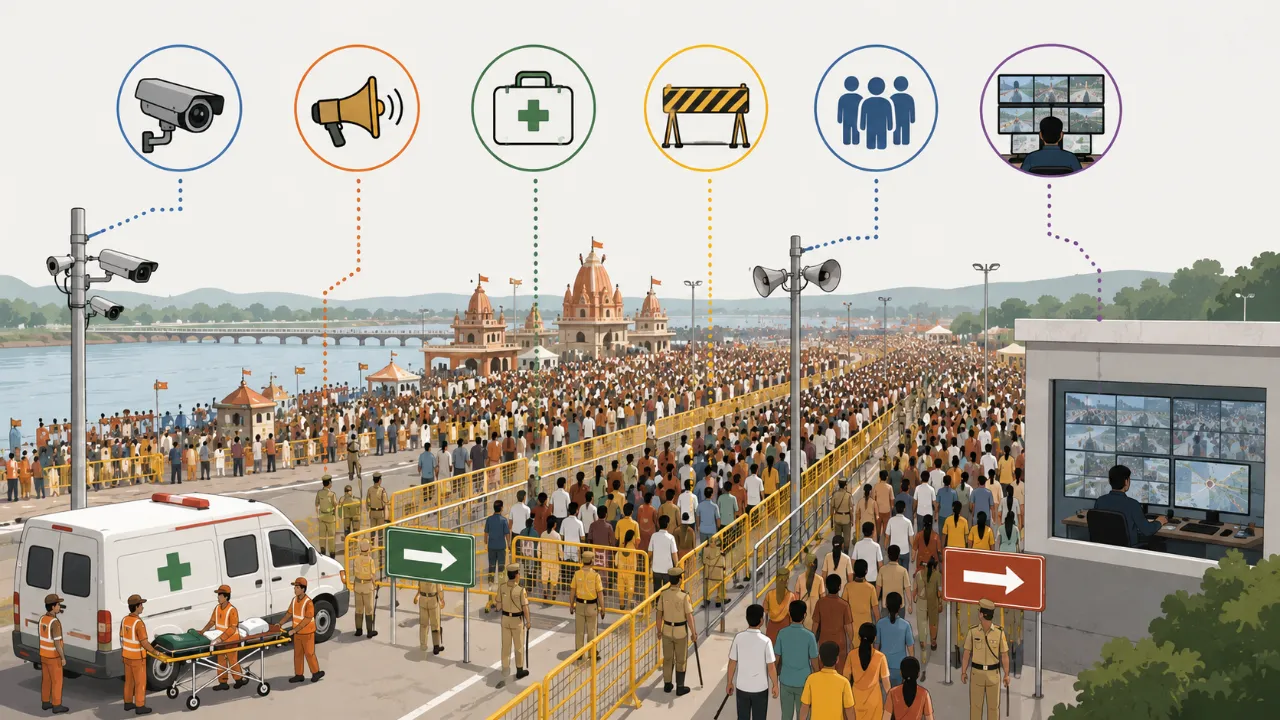
NDMA guidance emphasises regulating traffic, creating route maps, maintaining emergency exits and using barricading to manage queue movement.
The key lesson is simple: crowd safety depends as much on movement design as on the number of security personnel deployed.
4. NDMA Approach to Crowd Management
India already has an institutional framework for crowd-disaster prevention.
NDMA's approach focuses on planning and coordination before the event, risk assessment, capacity management, controlled entry and exit, communication systems, medical preparedness and coordination among police, administration, emergency responders and organisers.
The Ministry of Home Affairs has also stated that NDMA has circulated detailed guidelines for managing crowds at mass gatherings and that States and Union Territories have been advised to use these templates to prepare their own Standard Operating Procedures and checklists.
For organisers, this means crowd management cannot begin when people start panicking. It must begin with questions such as:
- What is the maximum safe capacity?
- Where are the entry and exit points?
- Where could a bottleneck develop?
- How will emergency vehicles enter?
- How will rumours be countered?
- Who has authority to stop further entry?
- How quickly can medical assistance reach the affected zone?
5. Technology and the Future of Crowd Safety
Technology can significantly improve the ability to detect dangerous crowd conditions before they become disasters.
CCTV networks, drones, digital communication systems, public-address systems, GIS-based mapping and real-time crowd-density monitoring can help authorities identify congestion and redirect movement. The wider disaster-management system is also increasingly moving toward technology-enabled preparedness and coordinated response.
However, technology should not become a substitute for basic planning. A sophisticated camera system cannot compensate for a poorly designed exit. Similarly, artificial intelligence cannot replace trained personnel capable of taking immediate decisions during a rapidly evolving emergency.
The ideal model is therefore technology + trained manpower + clear SOPs + accountable leadership.
What This Means for India
Stampede prevention is ultimately a question of governance capacity and public safety.
The constitutional division of responsibilities makes the issue particularly important. Police and public order fall within the State domain, while the Union Government provides national-level guidance and disaster-management frameworks.
India therefore needs a more institutionalised approach in which every major mass gathering has a scientifically prepared Crowd Management Plan, clearly defined responsibilities, pre-event risk assessment, capacity limits, emergency medical arrangements, alternative evacuation routes and regular mock drills.
There is also a strong need to learn systematically from previous incidents. An inquiry should not end with identifying individual negligence. It should examine why the system allowed a dangerous crowd condition to develop in the first place.
Prevention Measures: What Should Be Done?
Before the Event
Authorities should conduct a detailed hazard and capacity assessment, map entry and exit routes, identify bottlenecks, establish emergency lanes and ensure that temporary structures, electrical systems and barricades meet safety requirements.
Event organisers should also prepare contingency plans for rain, fire, power failure, rumours, medical emergencies and sudden increases in attendance.
During the Event
Crowd inflow must be continuously monitored. Once a safe capacity is reached, additional entry should be regulated rather than allowing density to rise indefinitely.
Clear multilingual announcements, visible signage, trained volunteers and functioning public-address systems can reduce confusion. NDMA also stresses the importance of route planning, barricading, CCTV monitoring and medical readiness.
Emergency Response
If a dangerous surge begins, the priority should be to stop additional inflow, create space, communicate clearly and activate medical and emergency teams.
Emergency responders should have pre-planned access routes. Hospitals in the surrounding area should be alerted for potential mass-casualty situations, while an integrated command structure should coordinate police, fire services, health teams, disaster-response personnel and event organisers.
Post-Event Accountability
Every serious crowd incident should lead to a structured after-action review.
The objective should be to identify failures in infrastructure, planning, communication, capacity estimation, command structure and emergency response—not merely to assign blame after lives have been lost.
What Happens Next
- Best case: States and local authorities fully implement NDMA-based SOPs, introduce scientific capacity mapping, strengthen technology-enabled monitoring and conduct regular mock drills, substantially reducing preventable crowd disasters.
- Most likely case: Crowd-management systems continue to improve at major events, but implementation quality remains uneven across States, districts and smaller religious venues.
- Worst case: Repeated high-footfall events continue to rely on reactive policing, inadequate capacity planning and improvised arrangements, allowing small disruptions to escalate into mass-casualty incidents.
Conclusion
Human stampedes in India should be understood as preventable crowd disasters rather than unavoidable consequences of large gatherings. Recent incidents in 2026 have once again demonstrated how quickly a crowded environment can become dangerous when panic, infrastructure weaknesses, bottlenecks and inadequate communication interact.
India already possesses substantial institutional knowledge through NDMA guidelines and disaster-management frameworks. The real challenge is consistent implementation at the ground level. Safe crowd management begins before the first person enters the venue—with capacity assessment, route design, trained personnel, real-time monitoring, emergency preparedness and clear accountability.
For UPSC aspirants, the issue connects Disaster Management, Governance, Public Order, Urban Planning, Technology, Social Issues, Public Health and Cooperative Federalism. A strong Mains answer should therefore move beyond “deploy more police” and analyse the entire chain from risk assessment → prevention → preparedness → response → recovery → accountability.
FAQs
What is a human stampede?
A human stampede is a dangerous crowd-disaster situation in which uncontrolled or highly compressed movement can cause people to fall, become trapped or suffer fatal injuries. It is generally associated with a combination of crowd density, movement restrictions, panic and environmental or infrastructural factors.
What are the major causes of stampedes in India?
Major risk factors include overcrowding, bottlenecks, inadequate exits, poor barricading, structural failures, fire or electrical hazards, rumours, communication failures and weak crowd-flow management. NDMA identifies structural, fire/electricity, crowd-control and crowd-behaviour factors among the major categories.
Who is responsible for crowd management in India?
Police and public order are State subjects, so State Governments and local authorities have primary responsibility. However, crowd management also requires coordination with district administration, event organisers, health services, fire services, disaster-management authorities and other agencies.
What are the important NDMA measures for preventing stampedes?
Important measures include capacity assessment, controlled entry, proper barricading, designated routes, emergency exits, CCTV monitoring, public communication, medical preparedness and inter-agency coordination.
Why is stampede prevention important for UPSC?
The topic has direct relevance to Disaster Management, Governance, Public Order, Social Issues, Public Health, Urban Planning and Technology. It also provides a strong case study for discussing preventive disaster management and institutional accountability.