India’s Employment Guarantee Scheme 2026: VB-G RAM G, Rural Jobs & UPSC Analysis
India’s Employment Guarantee Scheme 2026: VB-G RAM G, Rural Jobs & UPSC Analysis

Introduction
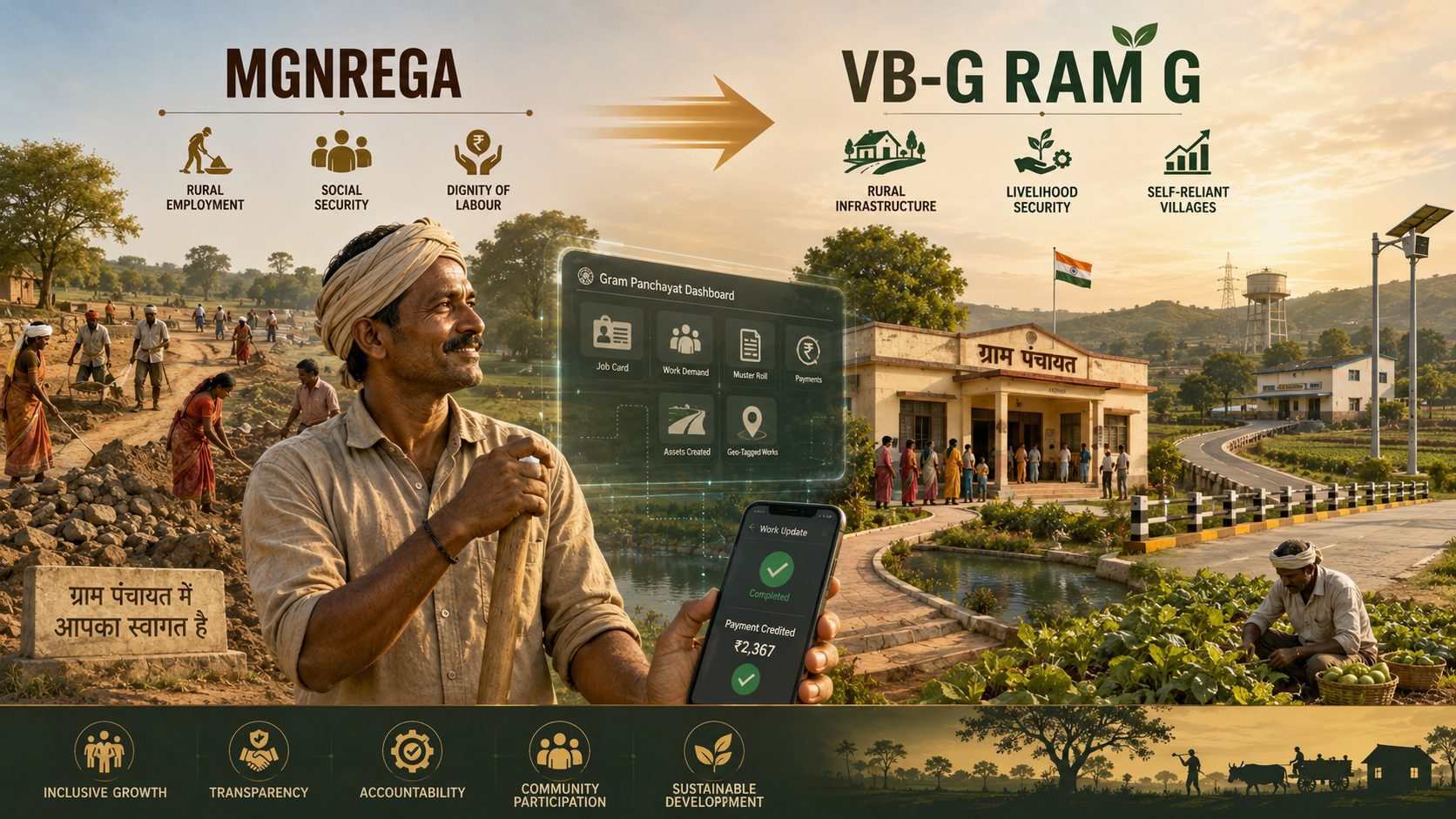
India’s rural employment guarantee framework entered a new phase on 1 July 2026, when the Viksit Bharat–Guarantee for Rozgar and Aajeevika Mission (Gramin), or VB-G RAM G Act, 2025, came into force across the country. The new framework replaced the Mahatma Gandhi National Rural Employment Guarantee Act (MGNREGA), increasing the statutory employment guarantee from 100 days to 125 days for eligible rural households whose adult members volunteer to undertake unskilled manual work.
The change is more significant than an increase in the number of guaranteed workdays. VB-G RAM G seeks to connect employment with durable rural assets, water security, sustainable livelihoods, rural infrastructure and climate resilience. At the same time, its implementation raises important questions around funding, demand for work, administrative capacity, wage payments and the ability of the new framework to provide employment when rural households actually need it.
Why This Matters Now
- MGNREGA has been replaced: From 1 July 2026, the new VB-G RAM G framework operates across rural India.
- Employment guarantee has increased: The statutory guarantee has risen from 100 to 125 days per financial year for eligible rural households.
- The focus is broader than wage employment: The new framework emphasises rural infrastructure, water-related works, livelihood assets and resilience against extreme weather events.
Background
MGNREGA was designed around a rights-based approach to rural employment, giving eligible rural households a statutory guarantee of wage employment when adult members volunteered for unskilled manual work. Over time, the programme became an important instrument for rural income support, asset creation and employment during periods of agricultural stress.
The 2025 legislation introduced a new framework aligned with the government’s Viksit Bharat @2047 objective. VB-G RAM G came into force on 1 July 2026, and the government states that existing MGNREGA job cards with completed e-KYC remained valid during the transition until new Gramin Rozgar Guarantee Cards were issued. Ongoing MGNREGA works could also continue and be migrated under the new framework.
Main Analysis
1. What Has Changed from MGNREGA to VB-G RAM G?
The most visible change is the increase in the statutory employment guarantee from 100 days to 125 days. But the new framework also places greater emphasis on linking employment generation with productive rural development.
The government describes VB-G RAM G as a framework for creating durable and productive rural assets while strengthening livelihoods and rural infrastructure. The law also retains the statutory character of the employment guarantee, including provisions relating to unemployment allowance when employment is not provided within the stipulated period.
This makes the transition important from a policy perspective: rural employment is increasingly being presented not only as income support but also as an instrument for building productive community assets.
2. Why 125 Days of Employment Matters
The increase from 100 to 125 days provides an additional 25 days of statutory employment opportunity to eligible rural households.
For households dependent on seasonal agriculture, casual labour and other irregular sources of income, additional guaranteed employment can act as a form of livelihood protection. The framework also provides for 25 days of employment outside the 60-day peak agricultural season notified by the State, according to the government’s description of the Act.
However, the number of guaranteed days alone does not determine the real impact. The effectiveness of the programme will depend on whether households can actually demand and obtain work, whether wages are paid on time, and whether local administrations can generate adequate works.
3. Rural Jobs Are Being Linked with Asset Creation
VB-G RAM G places considerable emphasis on durable and productive rural assets. Its priority areas include water-related works, core rural infrastructure, livelihood-related infrastructure and works aimed at mitigating extreme weather events.
This approach attempts to address a long-standing policy challenge: how to ensure that employment expenditure creates assets that continue to benefit villages after the wage payment is made.
For example, water conservation, rural infrastructure and climate-resilience works can potentially support agricultural productivity and reduce vulnerability to droughts, floods and other environmental stresses.
The policy logic is therefore straightforward: employment today should ideally strengthen livelihoods tomorrow.
4. Funding and Centre–State Responsibilities
Financing is a crucial part of the new framework. For 2026–27, the Central share provision for VB-G RAM G is ₹95,692.31 crore, while the overall programme outlay, including the corresponding estimated State share, is expected to exceed ₹1.51 lakh crore.
The Act also establishes different Centre–State funding patterns. The Centre–State ratio is 90:10 for North-Eastern States, Himalayan States and Jammu & Kashmir, and 60:40 for other States and Union Territories with legislature.
This creates an important federal dimension. States have a major role in implementation, planning and delivery, while the Union Government provides a substantial share of programme financing and establishes the broader statutory framework.
5. The Major Challenges in 2026
The transition from MGNREGA to VB-G RAM G will test administrative capacity as much as legislative design.
The first challenge is ensuring timely availability of work. A statutory guarantee has practical value only when rural households can successfully demand employment and receive it within the prescribed framework.
The second is timely wage payment. Delays can undermine the income-security function of an employment guarantee programme even when employment itself has been provided.
The third is implementation capacity at the local level. Gram Panchayats and other implementing agencies need adequate technical, administrative and planning capabilities to generate meaningful works and maintain transparency.
The fourth challenge is balancing employment with productive asset creation. If the pressure to generate person-days dominates planning, the quality and long-term utility of assets could suffer. Conversely, excessive emphasis on complex infrastructure projects could reduce the programme’s ability to respond quickly to household demand for employment.
Finally, there are continuing public concerns about the transition itself, including questions around the demand-driven character of the programme and whether implementation arrangements could affect employment opportunities. The government has stated that the statutory, demand-driven nature of the employment guarantee is preserved under VB-G RAM G.
What This Means for India
The shift to VB-G RAM G could reshape the role of rural employment policy in India.
From an economic perspective, guaranteed employment can provide income support to vulnerable rural households and potentially strengthen rural demand.
From a development perspective, linking wage employment with water security, infrastructure, livelihoods and climate resilience can improve the productive value of public expenditure.
From a federalism perspective, the new funding structure and the requirement for States to notify schemes consistent with the Act make Centre–State coordination critical.
The bigger question is therefore not simply whether India has increased guaranteed employment from 100 to 125 days. It is whether the new framework can combine employment security, timely payments, productive assets and accountable local governance at scale.
What Happens Next
- Best case: VB-G RAM G combines reliable employment with high-quality asset creation, timely wage payments and stronger rural livelihoods, making employment expenditure a driver of long-term rural resilience.
- Most likely case: The programme expands employment opportunities but implementation quality varies across States, with continued attention required on wage payments, work availability, local capacity and asset quality.
- Worst case: Administrative bottlenecks, inadequate work availability, delayed payments or weak local implementation reduce the practical value of the statutory guarantee despite the increase to 125 days.
Conclusion
India’s employment guarantee system has entered a new phase with the nationwide implementation of VB-G RAM G from 1 July 2026. The shift from MGNREGA to a 125-day employment guarantee represents a major change in the institutional framework of rural employment policy.
Yet the success of the programme will ultimately be measured not by the number of days written into the law, but by what happens on the ground: Can rural workers obtain employment when they need it? Are wages paid on time? Are public assets genuinely productive? And does the programme strengthen long-term livelihood security?
For UPSC aspirants, VB-G RAM G is an important case study linking employment, poverty, rural development, fiscal federalism, social security, decentralisation, climate resilience and inclusive growth. It is therefore relevant not only to Economy but also to Governance, Social Justice and the broader debate over rights-based welfare versus development-oriented public expenditure.
FAQs
What is VB-G RAM G?
VB-G RAM G is the Viksit Bharat–Guarantee for Rozgar and Aajeevika Mission (Gramin) framework established under the VB-G RAM G Act, 2025. It replaced MGNREGA from 1 July 2026.
How many days of employment are guaranteed under VB-G RAM G?
The Act provides a statutory guarantee of 125 days of wage employment per financial year to every eligible rural household whose adult members volunteer to undertake unskilled manual work.
What happened to MGNREGA?
MGNREGA stood repealed with effect from 1 July 2026, when the VB-G RAM G Act came into force nationwide. Ongoing works were allowed to continue and transition under the new framework.
Is VB-G RAM G still demand-driven?
The government states that the new framework preserves the statutory, demand-driven nature of the rural employment guarantee and retains provisions relating to unemployment allowance.
What are the major focus areas of VB-G RAM G?
The framework emphasises water-related works, core rural infrastructure, livelihood-related infrastructure, durable assets and mitigation of extreme weather events, alongside employment generation.