India’s Inflation Crisis: How Imported Inflation Could Push the Economy Toward Stagflation
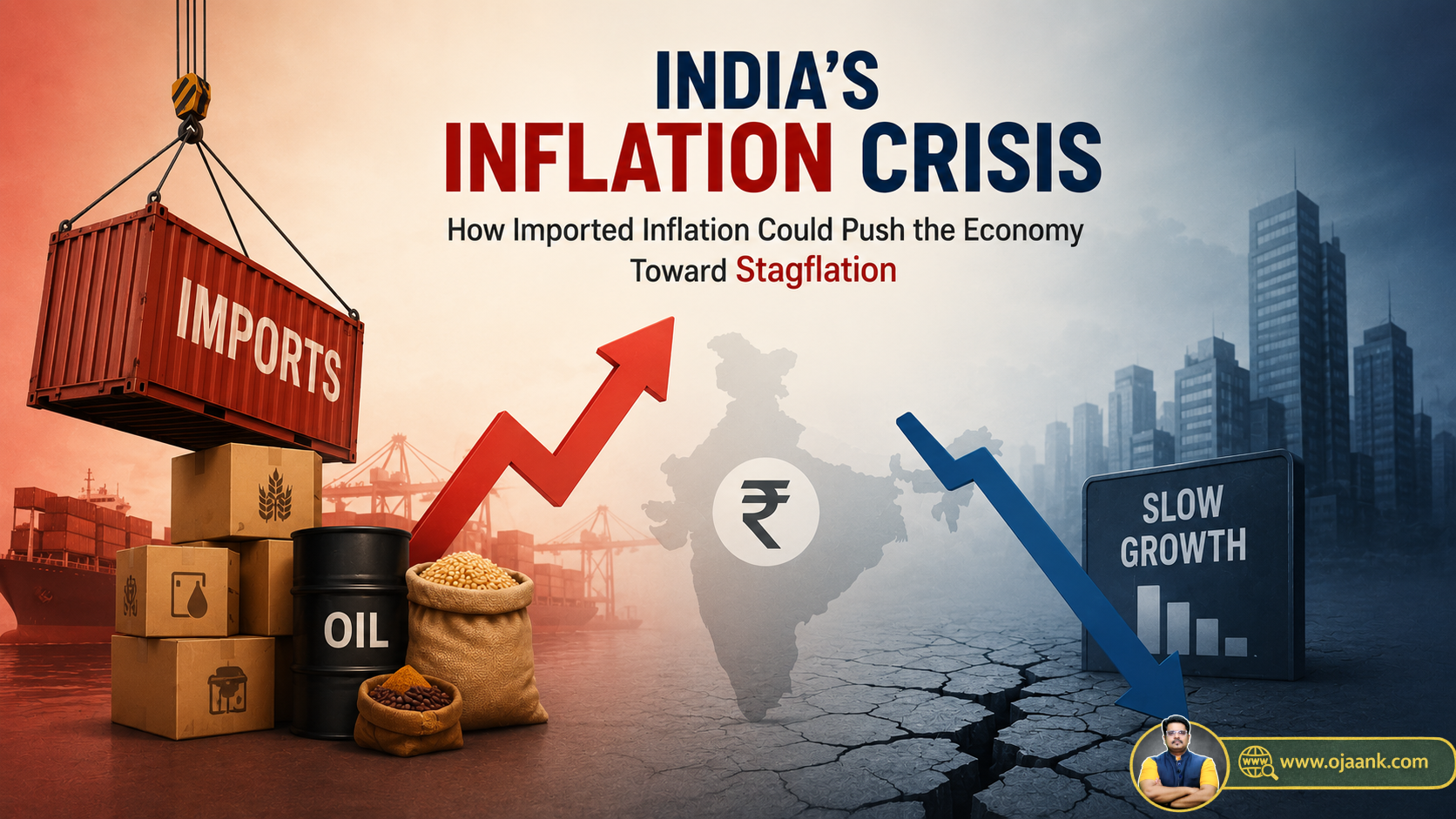
India’s Inflation Crisis: Is Imported Inflation Pushing the Economy Toward Stagflation?
Introduction
India’s inflation trend may appear stable on the surface, with CPI (Consumer Price Index) remaining within the RBI’s target range, but underlying economic pressures are steadily increasing. Rising WPI (Wholesale Price Index), volatile crude oil prices, rupee depreciation, and global geopolitical disruptions are creating fresh macroeconomic challenges for the Indian economy.
Economists describe this situation as a “deceptively benign inflation trend”—where retail inflation appears controlled while deeper inflationary pressures continue to build underneath. If these pressures persist, India could face the risk of stagflation, a condition marked by high inflation, slow economic growth, and rising unemployment.
Why is Inflation Rising in India?
India’s inflation is influenced by both domestic and global factors.
Major reasons include:
-
Heavy dependence on crude oil imports
-
Rupee depreciation
-
Global supply chain disruptions
-
Rising energy prices
-
Food inflation
-
Geopolitical conflicts
India imports a significant portion of its energy requirements. Therefore, any increase in global crude oil prices directly impacts:
-
Transportation costs
-
Food prices
-
Manufacturing costs
-
Electricity expenses
This creates widespread inflationary pressure across the economy.
Why is the CPI-WPI Divergence Important?
CPI (Consumer Price Index)
CPI measures retail inflation experienced by consumers.
WPI (Wholesale Price Index)
WPI tracks price changes at the wholesale and producer levels.
When WPI rises faster than CPI, it suggests the following:
-
Businesses are facing higher input costs
-
Retail inflation may rise in the future
-
Corporate profit margins are under pressure
This divergence indicates hidden inflationary stress within the economy.
What is Imported Inflation?
Imported inflation occurs when rising prices of imported goods increase domestic inflation.
In India, the biggest example is:
-
Crude oil imports
If:
-
The US dollar strengthens
-
The Indian rupee weakens
-
Global oil prices rise
then India’s import bill increases significantly, affecting the entire economy.
Is India Moving Toward Stagflation?
What is Stagflation?
"Stagflation" refers to a situation where
-
Inflation remains high
-
Economic growth slows down
-
Unemployment increases
Risks for India
India faces several warning signs:
-
Rising production costs
-
Weakening investment sentiment
-
Pressure on MSMEs
-
Slower job creation
-
Reduced consumer demand
If inflation continues rising while economic growth slows, India could face a serious macroeconomic challenge.
Social Impact of Inflation
Greater Burden on Poor Households
Fuel and food inflation disproportionately affect the following:
-
Low-income households
-
Rural populations
-
Vulnerable communities
Decline in Middle-Class Purchasing Power
Rising inflation leads to:
-
Lower real income
-
Reduced savings
-
Declining consumption capacity
Rising Inequality
Inflation affects different social groups unevenly, widening economic inequality.
Employment Concerns
If stagflation intensifies:
-
Job creation may slow
-
Unemployment could increase
-
Social unrest may rise
Political and Policy Challenges
RBI’s Policy Dilemma
The Reserve Bank of India faces a difficult balancing act between the following:
-
Controlling inflation
and -
Supporting economic growth
Higher interest rates may reduce inflation but can also slow investment and economic activity.
Government Challenges
The government must balance the following:
-
Fuel tax reductions
-
Subsidy management
-
Fiscal stability
Energy Security vs Climate Goals
India must simultaneously pursue the following:
-
Affordable energy
-
Energy security
-
Sustainable development
Economic Impact on India
Pressure on MSMEs
Micro, Small and Medium Enterprises are highly vulnerable to:
-
Rising input costs
-
Expensive raw materials
-
Weak consumer demand
Current Account Deficit (CAD)
Higher oil import bills increase:
-
Current Account Deficit
-
Pressure on the rupee
Impact on Investment Sentiment
Persistent inflation and slowing growth may:
-
Reduce investor confidence
-
Increase economic uncertainty
Role of Global Factors
India’s inflation is strongly influenced by global developments such as:
-
OPEC oil production decisions
-
Russia-Ukraine conflict
-
US dollar appreciation
-
Global recession risks
-
Supply chain disruptions
This makes the Indian economy highly sensitive to international shocks.
Can Renewable Energy Reduce Inflation Risks?
Experts argue that India’s long-term solution lies in accelerating investment in:
-
Solar energy
-
Wind power
-
Green hydrogen
-
Electric vehicles
-
Battery storage systems
Benefits of Renewable Transition
-
Reduced dependence on imported oil
-
Greater energy price stability
-
Lower long-term inflationary pressure
-
Better environmental sustainability
Role of Technology
Technologies such as:
-
AI-driven logistics
-
Digital supply chains
-
Smart grids
-
Precision agriculture
can improve efficiency and reduce inflationary pressures.
Historical Evolution of India’s Inflation Policy
| Year | Major Development |
|---|---|
| 1991 | LPG reforms increased global economic integration |
| 2016 | Inflation Targeting Framework adopted |
| Recent Years | Pandemic and wars increased global inflation pressures |
FAQs
1. What is Imported Inflation?
Imported inflation occurs when rising prices of imported goods, such as crude oil, increase domestic inflation.
2. What is Stagflation?
Stagflation is an economic condition characterized by high inflation, slow economic growth, and rising unemployment.
3. What is the difference between CPI and WPI?
CPI measures retail inflation faced by consumers, while WPI tracks price changes at the wholesale level.
4. Why is India highly vulnerable to inflation shocks?
India depends heavily on crude oil imports, making its economy sensitive to global energy price fluctuations.
5. Can Renewable Energy help control inflation?
Yes. Renewable energy can reduce dependence on imported fuel, stabilize energy costs, and lower long-term inflationary pressures.
Conclusion
India’s current inflation trend is not merely a short-term economic challenge but also a sign of deeper structural vulnerabilities. Even though CPI inflation appears controlled, rising WPI, energy costs, and global economic uncertainties signal growing macroeconomic risks ahead.
To avoid a stagflation-like situation, India must focus on:
-
Energy self-reliance
-
Stronger supply chains
-
Renewable energy transition
-
Balanced monetary and fiscal policies
India’s long-term economic stability will depend on how effectively it manages global inflationary shocks while sustaining growth and protecting vulnerable populations.