India’s Labour Unrest and Minimum Wage Crisis: Worker Rights, Labour Codes & Industrial Growth Explained
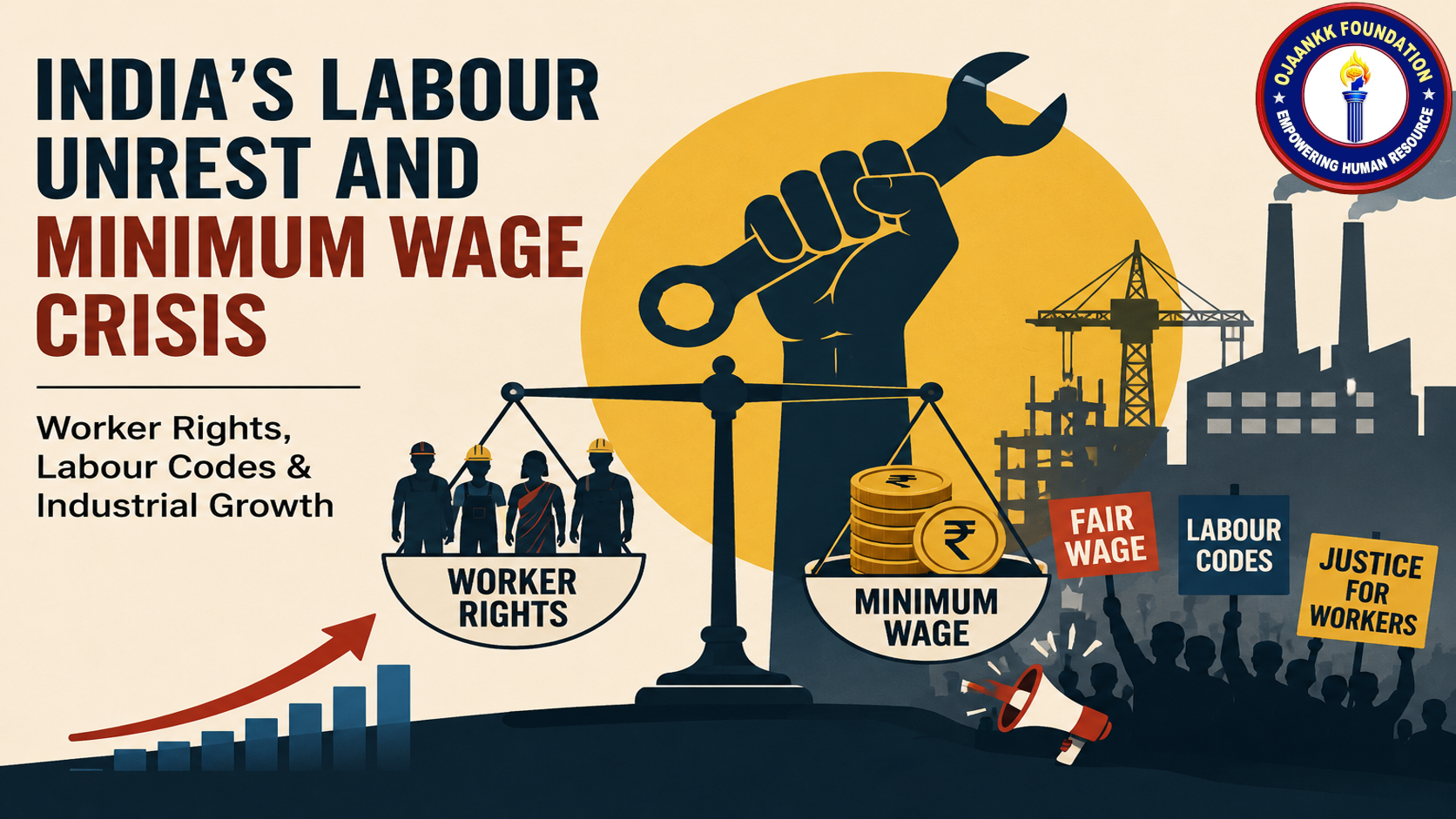
Labour Unrest and Minimum Wage Crisis in India: Can Worker Rights and Industrial Growth Coexist?
India’s major industrial belts such as Noida, Sriperumbudur, and other manufacturing hubs have recently witnessed rising labor unrest. Low wages, long working hours, contract-based employment, and weak implementation of labor codes have increased insecurity and dissatisfaction among workers.
The 2026 interim minimum wage revision by the Uttar Pradesh government, linked to CPI-based Variable Dearness Allowance (VDA), has intensified the debate over whether existing wage structures are sufficient to ensure a dignified standard of living for workers.
This issue is no longer limited to wages alone. It reflects a broader challenge involving labor rights, industrial competitiveness, ease of doing business, social justice, and the growing informalization of labor in India.
Why is labour unrest rising in India?
India’s labor ecosystem faces several structural challenges:
-
Slow growth in real wages
-
Rising inflation and living costs
-
Increasing contract-based employment
-
Weak social security coverage
-
Poor enforcement of labour laws
-
Long working hours and unsafe conditions
Despite rapid industrial growth, workers’ income and quality of life have not improved proportionately. As a result, labour protests and industrial disputes are increasing across multiple sectors.
What are minimum wages and labour codes?
Minimum Wages Act, 1948
This law ensures statutory minimum wages for workers across various sectors.
Code on Wages, 2019
The Code consolidated multiple wage-related laws and introduced the concept of a National Floor Wage.
Variable Dearness Allowance (VDA)
A wage component linked to inflation (CPI) designed to protect workers’ real income and purchasing power.
Contract Labour
Workers employed on temporary contracts without long-term job security or social protection.
Informal Sector
A segment of the economy characterized by:
-
Absence of formal contracts
-
Lack of social security
-
Weak labour protections
A significant portion of India’s workforce operates within this sector.
Social Impact of Wage Stagnation
Declining Quality of Life
Limited wage growth amid rising inflation makes it difficult for workers to afford:
-
Food
-
Housing
-
Fuel
-
Healthcare
Intergenerational Poverty
Low income affects:
-
Children’s education
-
Nutrition
-
Healthcare access
which perpetuates poverty across generations.
Growing Contract Labour Crisis
Increasing dependence on contract labour results in:
-
Reduced job security
-
Weak bargaining power
-
Higher risk of exploitation
This creates a dual labour market marked by inequality between formal and informal workers.
Political and Policy Challenges
Government Response
Labour protests are often treated as:
-
Law-and-order issues
rather than structural socio-economic problems.
Ease of Doing Business vs Labour Welfare
India faces a major policy dilemma between:
-
Attracting investment
and -
Protecting labour rights
Role of Centre and States
Minimum wage fixation involves both:
-
Central government
-
State governments
leading to wage disparities across states.
Challenges in Labour Codes
Although Labour Codes aim to simplify labour regulations:
-
Implementation gaps remain
-
Trade unions continue to raise concerns
-
Several provisions remain controversial
Economic Impact of Wage Reforms
Benefits of Higher Wages
Higher wages can:
-
Boost domestic consumption
-
Increase demand
-
Support economic growth
Pressure on Industries
At the same time, rising wages may:
-
Increase production costs
-
Reduce industrial profits
-
Encourage automation
Impact on MSMEs
Micro, Small and Medium Enterprises face significant pressure due to:
-
Limited capital
-
Rising labour costs
-
Weak demand conditions
Low Wage Growth and Economic Development
If wage growth remains weak:
-
Domestic demand declines
-
Worker productivity suffers
-
Inclusive growth weakens
Cultural Dimensions of Labour
Dignity of Labour in Indian Society
The idea of “Shram ka Samman” (dignity of labour) holds cultural significance in India. However, realities such as:
-
Migrant worker discrimination
-
Social insecurity
-
Workplace inequality
continue to persist.
Industrialisation and Labour Culture
Industrialisation has led to:
-
Rural-to-urban migration
-
Weakening traditional community support systems
-
Emergence of a new urban working-class identity
This has significantly transformed labour culture and aspirations.
Legal and Constitutional Framework
Major Labour Laws
Workers’ rights in India are governed through:
-
Code on Wages, 2019
-
Industrial Relations Code, 2020
-
Occupational Safety, Health and Working Conditions Code, 2020
Constitutional Protection
The Indian Constitution protects labour rights through:
-
Article 21
-
Article 23
Existing Legal Gaps
Major concerns include:
-
Weak law enforcement
-
Gap between minimum wage and living wage
-
Limited protection for informal workers
-
Restrictions on strike-related rights
International Perspective
Global Labour Standards
India competes with countries such as:
-
Vietnam
-
Bangladesh
through relatively low-cost labour models.
ILO Standards
The International Labour Organization emphasizes:
-
Decent work
-
Fair wages
-
Social protection
Global Lessons for India
India can learn from:
-
Living wage frameworks
-
Strong collective bargaining systems
-
Universal social security models
-
Balanced labour-market flexibility
Technology and Labour Dynamics
Impact of Automation
Technological advancements are:
-
Reducing low-skilled jobs
-
Expanding the gig economy
-
Increasing skill inequality
Technology for Labour Welfare
Technology can also improve labour welfare through:
-
Digital wage payments
-
Online grievance systems
-
Skill development platforms
Environmental and Regional Factors
Regional Wage Disparities
Differences in:
-
Cost of living
-
Industrial development
-
State labour policies
create large wage disparities across India.
Environmental Challenges
Climate change, energy crises, and industrial pollution disproportionately affect:
-
Construction workers
-
Informal labourers
-
Agricultural workers
Historical Background
| Year | Major Development |
|---|---|
| 1947–48 | Industrial Disputes Act & Minimum Wages Act enacted |
| 1991 | LPG reforms increased informalization. |
| 2019–20 | Labor codes introduced |
| 2024–26 | Rising labour unrest and implementation debates |
FAQs
1. What is the difference between Miminimum wagend living wage?
Minimum wage is the legally mandated minimum payment to workers, while living wage refers to an income sufficient for a dignified standard of living.
2. What is contract labour?
Contract labor refers to workers hired temporarily without long-term job security or comprehensive social protection.
3. What is Variable Dearness Allowance (VDA)?
VDA is a wage component linked to inflation (CPI) that helps maintain workers’ purchasing power.
4. Why are labour codes controversial?
Trade unions argue that some labour code provisions weaken worker protections and impose stricter restrictions on strikes.
5. Why is labour unrest increasing in India?
Low wages, inflation, contract employment, weak social security, and poor working conditions are major reasons behind rising labor unrest.
Conclusion
India’s labor ecosystem stands at a critical turning point. While the country aims to become a global manufacturing hub, rising labor unrest, low wages, and inadequate social protection are emerging as serious structural challenges.
If India wants to achieve sustainable and inclusive industrial growth, it must focus on:
-
Strong labour rights protection
-
Fair wages
-
Expanded social security
-
Effective labour law enforcement
-
Skill development
True economic progress will only be possible when industrial growth and worker welfare move forward together in a balanced and equitable manner.
Click here for more blogs
https://www.ojaank.com/blog/daily-current-affairs