Maritime Chokepoints of West Asian Energy Trade
Maritime Chokepoints of West Asian Energy Trade
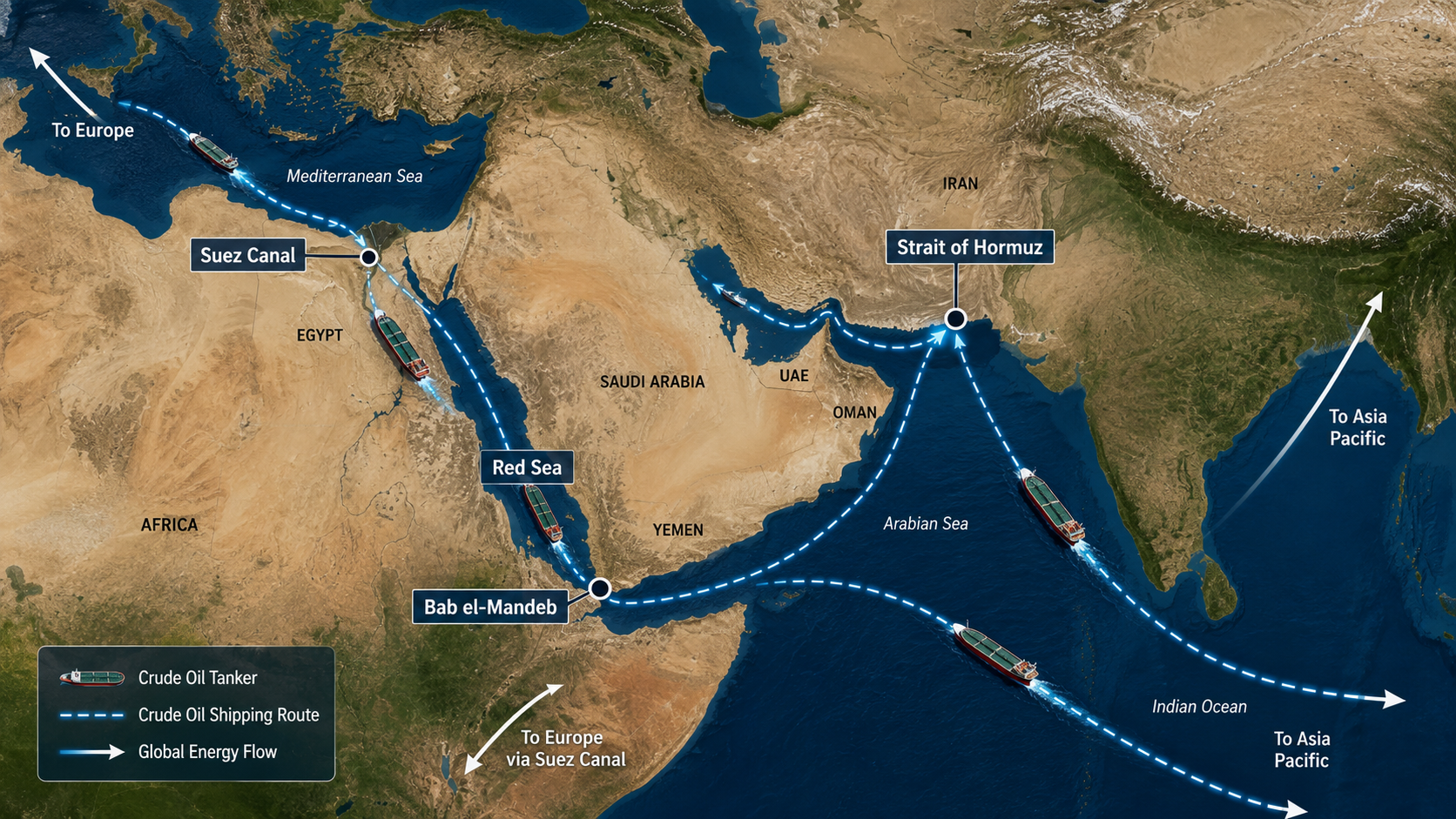

Recent attacks near the Bab el-Mandeb Strait have disrupted Saudi-linked shipping, increased insurance premiums, and pushed global crude oil prices higher. The incidents have once again highlighted the vulnerability of maritime trade routes that connect West Asia with international energy markets.
These narrow sea passages serve as the backbone of global oil transportation. Even localized disruptions can ripple across international trade, affecting shipping costs, fuel prices, inflation, and the energy security of importing countries such as India.
Why This Matters Now
- Rising security threats in the Red Sea are increasing risks to global energy supply chains.
- Higher freight and insurance costs directly influence international crude oil prices.
- India, one of the world's largest oil importers, closely monitors these maritime routes for uninterrupted energy supplies.
Background
West Asia contains some of the world's most strategically important maritime passages. The majority of crude oil exported from the Persian Gulf travels through the Strait of Hormuz, while ships heading towards Europe via the Red Sea must pass through Bab el-Mandeb before entering the Suez Canal.
Because these waterways are narrow and carry enormous volumes of international trade, they are commonly known as maritime chokepoints. Any conflict, piracy, or military activity in these regions can significantly disrupt global shipping.
Main Analysis
Bab el-Mandeb: Gateway Between the Red Sea and the Indian Ocean
The Bab el-Mandeb Strait lies between Yemen and the Horn of Africa, linking the Red Sea with the Gulf of Aden and the Arabian Sea. It is an essential passage for ships moving between Europe and Asia through the Suez Canal.
Its strategic location makes it particularly vulnerable to regional conflicts and attacks on commercial shipping.
Strait of Hormuz: The World's Most Important Oil Passage
Located between Iran and Oman, the Strait of Hormuz serves as the principal maritime outlet for the Persian Gulf. A substantial share of global crude oil exports passes through this narrow waterway every day.
Any disruption here has immediate implications for international energy markets because there are limited alternatives for transporting Gulf oil.
Economic Impact of Maritime Disruptions
Disruptions along these shipping routes increase freight charges, marine insurance premiums, delivery times, and fuel costs. These higher transportation expenses often translate into rising international crude oil benchmark prices, affecting economies worldwide.
Longer shipping routes also increase operational costs for shipping companies and reduce supply chain efficiency.
Alternative Energy Transport Routes
Saudi Arabia's East–West Pipeline provides an alternative route by transporting crude oil from eastern oil fields to terminals on the Red Sea. This pipeline can partially bypass the Strait of Hormuz during emergencies.
However, exports destined for Europe through the Red Sea may still depend on safe navigation across the Bab el-Mandeb Strait.
International Maritime Law and Navigation Rights
The United Nations Convention on the Law of the Sea (UNCLOS) grants transit-passage rights through international straits used for global navigation. Coastal states are generally expected not to obstruct such passage except in accordance with international law.
This legal framework seeks to maintain uninterrupted international commerce through critical maritime routes.
What This Means for India
India imports a significant share of its crude oil from West Asia. Any instability around the Strait of Hormuz or Bab el-Mandeb can increase India's import bill, raise domestic fuel prices, and widen inflationary pressures.
Secure maritime trade routes are therefore essential for India's energy security, economic stability, and strategic interests in the Indian Ocean Region.
What Happens Next
Best Case
Regional security improves, commercial shipping resumes normally, and global oil prices stabilize.
Most Likely Case
Periodic disruptions continue, keeping freight rates and insurance costs elevated while global energy markets remain cautious.
Worst Case
Major escalation results in prolonged disruption of maritime traffic, forcing ships to reroute around the Cape of Good Hope, significantly increasing transportation time, fuel consumption, and global energy prices.
Conclusion
Maritime chokepoints such as the Bab el-Mandeb Strait and the Strait of Hormuz are indispensable to global energy trade. Their strategic geography means that even limited disruptions can affect oil prices, shipping networks, and economic stability across continents. For India, ensuring secure sea lanes and diversifying energy transport routes remain vital components of long-term energy security and foreign policy.
Frequently Asked Questions (FAQs)
▶ Q1: What is a maritime chokepoint?
Answer: A maritime chokepoint is a narrow sea route through which a large volume of international trade, especially energy shipments, passes.
▶ Q2: Why is the Strait of Hormuz important?
Answer: It is the principal maritime outlet of the Persian Gulf and one of the world's busiest routes for crude oil exports.
▶ Q3: Where is Bab el-Mandeb located?
Answer: It lies between Yemen and the Horn of Africa, connecting the Red Sea with the Gulf of Aden.
▶ Q4: What happens if these routes are disrupted?
Answer: Shipping costs, insurance premiums, delivery times, and global crude oil prices typically increase.
▶ Q5: Why is this important for India?
Answer: India depends heavily on imported crude oil from West Asia, making uninterrupted maritime trade crucial for its energy security and economic stability.