Medicine Price Gap in India: Why Parliament Wants a 20% Cap? Complete UPSC Analysis
Medicine Price Gap in India: Why Parliament Wants a 20% Cap? Complete UPSC Analysis

Introduction
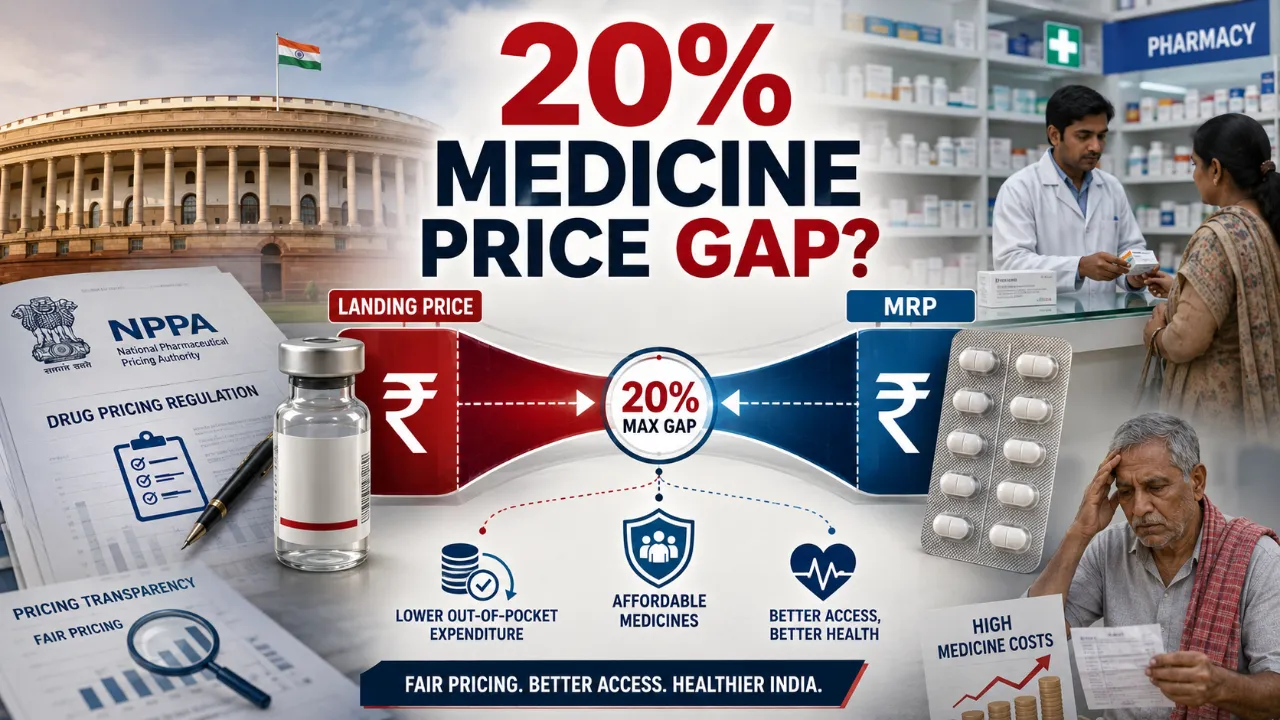
The price of a medicine in India can involve several layers between the point at which a product enters the market and the price ultimately printed on its pack. This gap has now become the focus of a major recommendation by the Department-related Parliamentary Standing Committee on Health and Family Welfare. In its 176th Report, Affordability and Accessibility of Healthcare Facilities in Public and Private Sector, the Committee recommended that the gap between the landing price of medicines and medical devices and their Maximum Retail Price (MRP) should not exceed 20%. The report was presented to Parliament on 7 August 2026.
The recommendation is important because medicine affordability is not determined only by the manufacturer's production cost. Distribution margins, retailer and stockist margins, hospital procurement practices and the final MRP can influence what patients actually pay. However, the proposed 20% ceiling is a parliamentary committee recommendation, not a new nationwide legal price cap currently in force. Existing medicine price regulation continues primarily under the Drugs (Prices Control) Order, 2013, administered by the National Pharmaceutical Pricing Authority (NPPA).
Why This Matters Now
- A 20% gap has been proposed: The Parliamentary Standing Committee on Health and Family Welfare recommended limiting the difference between landing price and MRP of medicines and medical devices to 20%.
- The proposal targets affordability: The Committee linked wide price differences with higher out-of-pocket expenditure and called for greater transparency and rationalisation of healthcare costs.
- India already has a drug-price regulator: Under DPCO 2013, the NPPA fixes ceiling prices for scheduled formulations and regulates certain other medicines, but the supply-chain margins at different levels are not generally regulated as a single uniform 20% cap.
Background
India's pharmaceutical pricing system is based largely on the Drugs (Prices Control) Order, 2013, which operates within the framework of the National Pharmaceutical Pricing Policy, 2012. The NPPA regulates scheduled medicines by fixing ceiling prices for formulations included in Schedule-I of DPCO, which is based on the National List of Essential Medicines (NLEM).
Under the existing market-based pricing methodology, the ceiling price of a scheduled formulation is generally derived from the average Price to Retailer (PTR) of qualifying brands and includes a 16% retailer margin. For non-scheduled formulations, manufacturers cannot increase MRP by more than 10% during the preceding 12 months.
This distinction is crucial. Price control of selected medicines is not the same thing as controlling every margin between the medicine's entry price and its final MRP. The latest parliamentary recommendation is therefore aimed at addressing a wider pricing issue across the supply chain.
Main Analysis
1. What Is the Medicine Price Gap?
The medicine price gap broadly refers to the difference between the price at which a product enters the market or reaches the supply chain and the price at which it is finally offered to the consumer.
The parliamentary recommendation specifically refers to the gap between the landing price and the MRP. Landing price can be understood as the cost at which a medicine or medical device enters the market, while MRP represents the maximum price printed for retail sale to consumers. The wider the difference, the greater the possibility of additional margins accumulating between different stages of the supply chain.
A high gap does not automatically mean that the entire difference is profit. Logistics, warehousing, distribution, marketing, taxes and other legitimate costs can exist between entry into the market and retail sale. The policy challenge is therefore to distinguish reasonable costs and margins from excessive or opaque mark-ups.
That is precisely why the Committee has called for greater scrutiny of pricing structures rather than simply focusing on manufacturing costs.
2. Why Has Parliament’s Committee Proposed a 20% Cap?
The Committee's central concern is healthcare affordability.
Medical expenditure can become financially damaging when patients have little ability to postpone or substitute treatment. Unlike many consumer products, essential medicines are often purchased because they are medically necessary. This weakens the patient's bargaining power.
The Committee has therefore recommended measures to reduce arbitrary price differences and strengthen transparency across medicines, medical devices and private healthcare services. Its wider report contains 368 recommendations covering healthcare infrastructure, private hospitals, insurance, medicines, medical devices and patient access.
The proposed 20% ceiling is thus part of a broader policy argument: healthcare markets require stronger transparency and regulation where patients cannot easily negotiate prices or delay consumption.
3. How Is the Existing NPPA System Different?
The NPPA already regulates prices of medicines under DPCO 2013.
For medicines listed under Schedule-I, which is based on NLEM, the NPPA fixes ceiling prices. As of 23 July 2026, ceiling prices for 935 scheduled formulations were effective. The government has also stated that NLEM 2022 contains 388 medicines across 29 therapeutic categories.
However, the present system does not impose a blanket 20% ceiling on the difference between every medicine's landing price and MRP.
The government has also stated that margins at various levels of the supply chain are currently not regulated as a single uniform framework and are guided by commercial considerations.
This is the policy gap that the parliamentary recommendation seeks to examine.
In simple terms:
Existing system: Regulate prices of specified medicines through ceiling-price mechanisms.
Proposed reform: Examine the entire price chain and restrict the landing-price-to-MRP gap to a specified level.
4. The Tenecteplase Example: Why the Issue Matters
The debate has gained attention partly because of examples cited in coverage of the parliamentary recommendation.
One reported example concerns Tenecteplase, a clot-busting medicine used in emergency treatment. The parliamentary panel was reported to have highlighted a large difference between its landing cost and MRP, with figures of approximately ₹18,000 and ₹50,000, respectively.
This example illustrates why policymakers are interested in the entire pricing chain.
However, one important analytical caution is necessary: a difference between landing price and MRP should not automatically be interpreted as pure profit or profiteering. A complete assessment would need to examine distribution, storage, marketing, taxes, retailer margins, hospital procurement and other costs.
For UPSC answers, this distinction demonstrates balanced policy analysis rather than simply accepting the headline claim.
5. What Could a 20% Cap Change?
If implemented after appropriate regulatory design, a 20% landing-price-to-MRP ceiling could potentially reduce excessive mark-ups and make medicine pricing more transparent.
Patients could benefit through lower retail prices, particularly where the current supply-chain gap is unusually large. Hospitals and pharmacies could face greater pressure to disclose procurement and pricing structures.
The proposal could also strengthen competition based on actual value rather than high printed MRPs.
But implementation would be complex.
The government would need a clear definition of landing price, establish which costs can legitimately be added, decide how imported medicines should be treated, and create mechanisms to monitor violations across manufacturers, distributors, hospitals and retailers.
A poorly designed cap could also create unintended consequences. If margins become too low for certain low-volume or difficult-to-distribute medicines, suppliers could have weaker incentives to stock them. For essential and emergency medicines, availability is as important as affordability.
6. Medicine Price Control vs Medicine Availability
One of the biggest policy challenges is balancing affordability with availability.
Price controls can protect patients from excessive prices, but pharmaceutical markets also require manufacturers and distributors to maintain production, supply chains and inventories.
The government itself has acknowledged the need to balance affordable medicines with sufficient opportunity for innovation and competition. The existing pricing policy therefore follows principles of essentiality and market-based pricing rather than attempting to impose cost-based controls on every medicine.
This creates a classic public-policy trade-off:
Too little regulation → excessive prices and higher financial burden.
Too much or poorly designed regulation → possible supply disruptions, reduced incentives and market distortions.
The ideal policy must therefore target unreasonable margins without weakening the medicine supply chain.
What This Means for India
The 20% proposal has implications beyond pharmaceutical pricing.
Healthcare Affordability
Lower medicine prices can directly reduce the financial burden on households. This matters because medicines are a recurring component of healthcare expenditure, especially for chronic conditions.
Out-of-Pocket Expenditure
India has historically faced substantial out-of-pocket healthcare expenditure. The parliamentary committee's broader recommendations therefore focus on medicines, diagnostics, hospital charges and insurance together rather than treating drug pricing as an isolated issue.
Pharmaceutical Supply Chain
A price-gap cap would require greater transparency from manufacturers, distributors, stockists, retailers and hospitals. Digital invoicing and traceable supply chains could become increasingly important.
Generic Medicines
Greater access to affordable generic medicines can complement price regulation. The parliamentary panel has also recommended expansion of Jan Aushadhi Kendras and greater availability of affordable medicines through public healthcare facilities and private empanelled hospitals.
Medical Devices
The recommendation is not restricted to medicines. The Committee has also discussed medical devices and consumables, including the need to reduce excessive differences between landed prices and consumer-facing prices.
Existing Government Measures
The 20% proposal comes on top of an existing regulatory architecture.
National Pharmaceutical Pricing Authority
The NPPA is responsible for implementing pharmaceutical price regulation under DPCO 2013. It fixes ceiling prices for scheduled formulations and retail prices for certain new drugs. As of July 2026, 935 scheduled formulations had effective ceiling prices.
National List of Essential Medicines
The NLEM identifies medicines considered essential for priority healthcare needs and forms the basis for the scheduled medicines covered under DPCO.
Jan Aushadhi
The Pradhan Mantri Bhartiya Janaushadhi Pariyojana aims to make quality generic medicines available at affordable prices through dedicated outlets.
AMRIT Pharmacies
The AMRIT Pharmacy network provides medicines and medical devices at discounted prices through designated facilities.
Trade Margin Rationalisation
India has previously used trade-margin controls for selected medicines in exceptional public-interest situations. For example, the government states that NPPA capped trade margins for 42 selected non-scheduled anti-cancer medicines in 2019, reducing prices of more than 500 brands by an average of about 50%.
These examples show that India has already experimented with targeted margin regulation, although the proposed 20% framework would be much broader.
Key Challenges in Implementing a 20% Cap
Defining the Landing Price
The first challenge is deciding exactly what constitutes the landing price. Imported medicines, domestically manufactured products and medicines supplied through different distribution channels may have different cost structures.
Preventing Supply Disruptions
A rigid ceiling could affect the commercial viability of medicines with high logistics, storage or distribution costs. Essential medicines must remain continuously available.
Monitoring the Entire Supply Chain
Monitoring manufacturers alone would not be sufficient. The system would need visibility across distributors, stockists, retailers and hospitals.
Imported Medicines
Imported products may involve customs duties, freight, insurance, warehousing and other costs. A uniform formula would have to account for these differences without creating loopholes.
Innovation and Competition
India is a major pharmaceutical manufacturing hub. Pricing regulation must therefore protect affordability while preserving incentives for research, innovation, quality and new-product development.
Enforcement
A price ceiling has little value without effective enforcement. The regulator would need reliable data, auditing powers, complaint mechanisms and meaningful penalties for violations.
The Way Forward
A balanced approach should combine price regulation with transparency and competition.
First, the government should conduct a detailed study of medicine pricing across the entire supply chain before applying a uniform cap.
Second, landing price, distributor margins, retailer margins and MRP should be made more transparent through standardised digital records.
Third, essential medicines should receive priority in any new margin-control framework.
Fourth, price regulation should be periodically reviewed to account for changes in input costs, exchange rates, logistics and availability.
Fifth, Jan Aushadhi and other affordable-medicine channels should be expanded so that patients have genuine alternatives.
Finally, regulation should distinguish between unreasonable mark-ups and legitimate supply-chain costs. The objective should be affordable medicines without creating shortages.
What Happens Next
- Best case: The government adopts a transparent, evidence-based margin framework that reduces excessive medicine prices while preserving supply, quality, competition and pharmaceutical innovation.
- Most likely case: The 20% recommendation triggers further study and stakeholder consultation, followed by targeted regulation rather than an immediate blanket cap across all medicines and devices.
- Worst case: A rigid or poorly designed cap creates supply distortions, reduces availability of some medicines or encourages manufacturers and distributors to restructure pricing in ways that weaken the intended consumer benefit.
Conclusion
The parliamentary proposal for a 20% cap on the gap between landing price and MRP has brought a fundamental question of India's healthcare system back into focus: How should the country balance affordable medicines with a viable pharmaceutical supply chain?
India already regulates many essential medicines through the NPPA and DPCO 2013 framework. The new recommendation goes a step further by focusing on the broader gap between the price at which a medicine enters the market and the maximum price ultimately visible to consumers.
But the proposal should not be confused with an existing law. It is a recommendation of a Parliamentary Standing Committee, and its eventual impact will depend on how the government responds and whether an enforceable framework is subsequently created.
For UPSC aspirants, the issue is a strong example of the intersection between healthcare affordability, pharmaceutical regulation, market-based pricing, public welfare, competition, consumer protection and regulatory governance.
The larger lesson is clear: affordable healthcare is not achieved simply by lowering one price; it requires transparency across the entire healthcare value chain.
FAQs
What is the proposed 20% cap on medicine prices?
The Parliamentary Standing Committee on Health and Family Welfare has recommended that the gap between the landing price and MRP of medicines and medical devices should not exceed 20%. It is a committee recommendation, not an automatically applicable nationwide law.
Is there already a 20% price cap on all medicines in India?
No. Existing medicine-price regulation operates mainly under DPCO 2013. The NPPA fixes ceiling prices for scheduled formulations and regulates certain other medicines. The proposed 20% landing-price-to-MRP limit is a new recommendation.
What is the role of NPPA?
The National Pharmaceutical Pricing Authority regulates medicine prices under DPCO 2013, including fixing ceiling prices for scheduled formulations and retail prices for certain new drugs.
What is the difference between landing price and MRP?
Landing price refers broadly to the price at which a medicine or medical device reaches the market, while MRP is the maximum retail price printed for sale to consumers. The difference can reflect legitimate costs and margins, so it should not automatically be treated as profit.
Why is medicine affordability important for UPSC?
Medicine pricing connects healthcare access, public health, consumer protection, poverty, out-of-pocket expenditure, pharmaceutical regulation, competition policy and welfare governance. It is therefore relevant to GS-II, GS-III and Essay.