PM Modi’s Netherlands Visit Sparks Debate on Press Freedom, Democracy and Minority Rights in India
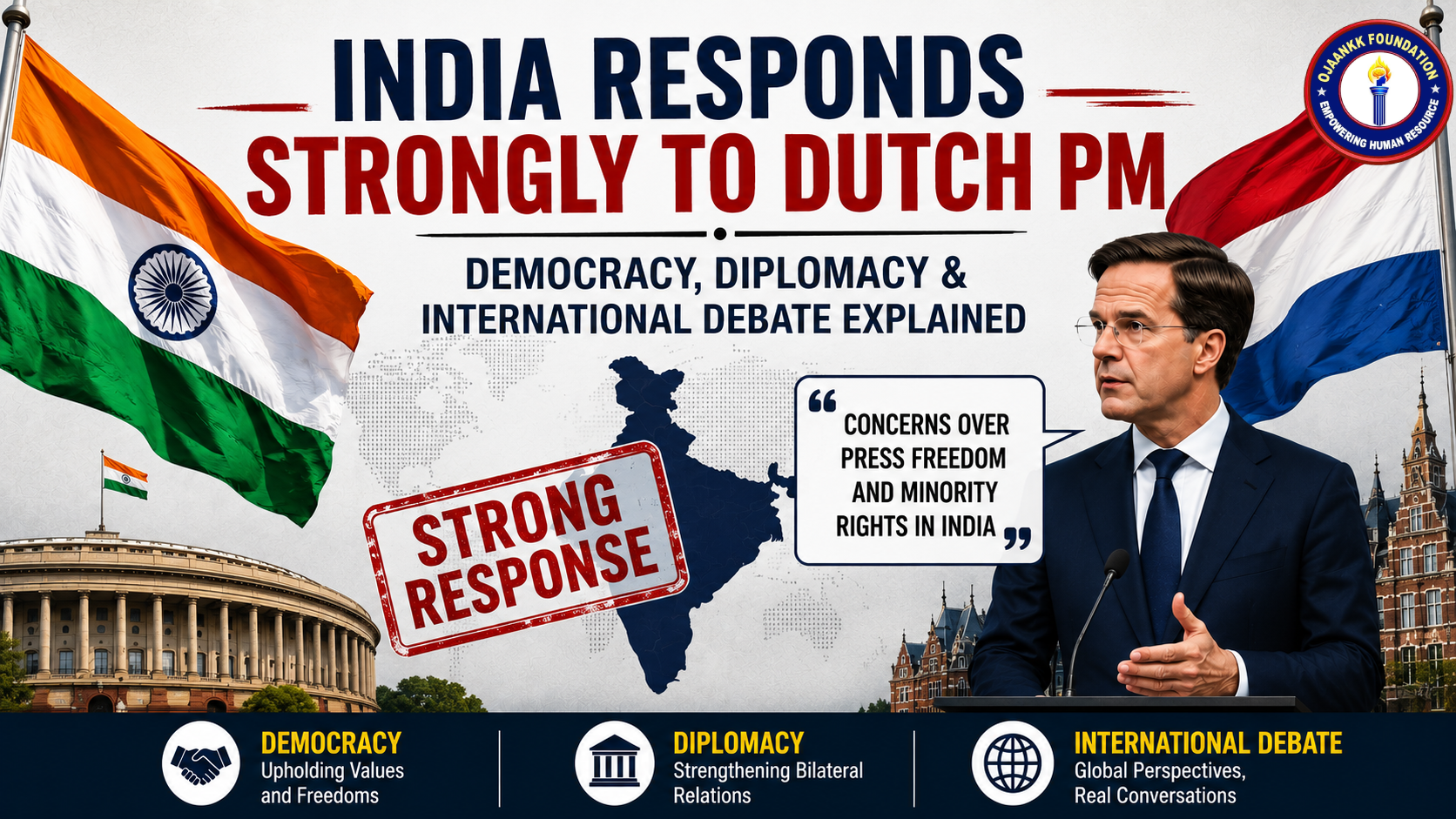
India Rejects Dutch PM’s Remarks on Press Freedom and Minority Rights: Diplomacy, Democracy and Global Perception Explained
Introduction:
Prime Minister Narendra Modi’s recent visit to the Netherlands became the center of international attention after remarks linked to press freedom and minority rights triggered a diplomatic debate between India and the Dutch leadership. During the visit, India strongly rejected comments reportedly made by the Dutch Prime Minister regarding democratic freedoms, media independence, and minority rights in India. (https://www.ojaank.com/)
India’s response was immediate and firm. Officials from the Ministry of External Affairs stated that such observations reflected a “lack of understanding” about India’s constitutional framework, democratic traditions, and cultural diversity. The controversy quickly evolved beyond bilateral diplomacy and sparked wider discussions on the following:
-
Democracy
-
Sovereignty
-
Human rights
-
Media freedom
-
Global perception of India
-
International diplomacy
As India’s global influence continues to rise, international scrutiny surrounding democratic institutions, press freedom, and minority rights is becoming increasingly significant in shaping foreign relations and global narratives.
What Happened During PM Modi’s Netherlands Visit?
Prime Minister Narendra Modi visited the Netherlands to strengthen strategic and economic cooperation between the two countries. During the visit:
-
India and the Netherlands expanded bilateral strategic partnership
-
Agreements were discussed in:
-
Semiconductors
-
Green hydrogen
-
Renewable energy
-
Technology cooperation
-
Trade and mobility
-
However, alongside these developments, questions emerged regarding the following:
-
Freedom of expression
-
Press freedom
-
Minority rights in India
The issue gained diplomatic attention after Dutch concerns regarding democratic values were publicly discussed. India responded by categorically rejecting claims of democratic decline.
India’s Official Response
India defended its democratic credentials strongly and emphasized:
-
India is the world’s largest democracy
-
Elections are conducted peacefully
-
Multiple religions coexist within constitutional protection
-
Democratic institutions remain active and independent
Indian officials highlighted that:
-
Hinduism
-
Buddhism
-
Jainism
-
Sikhism
originated in India and continue to flourish alongside:
-
Islam
-
Christianity
-
Judaism
-
Other minority communities
India also argued that the country’s minority population has grown significantly since independence, demonstrating constitutional protection and social coexistence.
The government maintained that selective criticism often ignores India’s democratic complexity, federal structure, and cultural diversity.
Why is Press Freedom in India Under Global Discussion?
India has increasingly faced international attention regarding:
-
Media independence
-
Online censorship
-
Legal action against journalists
-
Digital regulation
-
Freedom of expression
International media organizations and democracy watchdogs have raised concerns over:
-
Use of national security laws
-
Defamation provisions
-
Restrictions on digital platforms
-
Pressure on independent journalism
At the same time, India argues that:
-
The country has one of the world’s largest media ecosystems
-
Government criticism remains common in public discourse
-
Social media and digital journalism remain highly active
This creates a clear divide between:
-
International perception
and -
India’s official position
Minority Rights Debate in India
The controversy also revived global discussions regarding minority rights in India.
Some international organizations have expressed concerns over:
-
Religious polarization
-
Hate speech
-
Communal tensions
-
Discrimination allegations
However, India consistently rejects these claims and argues that:
-
All citizens are constitutionally equal
-
Minority communities actively participate in politics, business, education, and governance
-
India’s diversity remains one of its greatest democratic strengths
India views many external criticisms as:
-
Selective narratives
-
Politically motivated observations
-
Interference in domestic affairs
Sovereignty vs International Criticism
The debate reflects a larger question in international politics:
Should foreign governments publicly comment on another country’s internal democratic issues?
India has repeatedly stated that:
-
Democracy-related matters are internal affairs
-
Sovereignty must be respected
-
Selective criticism creates diplomatic imbalance
Western countries, particularly in Europe, often place strong emphasis on:
-
Human rights
-
Democratic governance
-
Media freedom
This creates periodic diplomatic friction between:
-
Strategic cooperation
and -
Value-based criticism
Why This Issue Matters Globally
1. India’s Rising Global Role
India is emerging as:
-
A major economic power
-
A strategic Indo-Pacific player
-
A technology and manufacturing hub
-
A leading voice of the Global South
As India’s influence increases, global scrutiny regarding democratic institutions naturally intensifies.
2. Impact on India-Europe Relations
Europe considers India an important partner in:
-
Trade
-
Technology
-
Green energy
-
Supply chain diversification
-
Indo-Pacific security
However, Europe also frequently raises issues linked to:
-
Democracy
-
Human rights
-
Media freedom
This creates a balance between:
-
Strategic interests
and -
Democratic values
3. Global Image and Soft Power
In the modern geopolitical environment, international perception affects:
-
Foreign investment
-
Diplomatic influence
-
Global partnerships
-
Soft power image
Narratives around democracy and rights therefore increasingly shape international relations.
Press Freedom vs National Security
A major debate within India — and globally — is balancing:
-
Freedom of expression
with -
National security
Supporters of stricter regulation argue:
-
Fake news can threaten social stability
-
Digital misinformation spreads rapidly
-
Regulation is necessary in the online era
Critics argue:
-
Excessive regulation may limit independent journalism
-
Fear of legal action can reduce press freedom
-
Media concentration weakens democratic accountability
This debate is not unique to India and is visible in many democracies worldwide.
India’s Democratic Strengths
Despite criticism, India continues to demonstrate several democratic strengths:
-
Massive electoral participation
-
Peaceful transfer of power
-
Active judiciary
-
Multi-party political competition
-
Large digital media ecosystem
-
Strong constitutional framework
India’s social and cultural diversity remains one of the largest democratic experiments in the world.
Key Challenges India Still Faces
India also faces important structural challenges:
-
Political polarization
-
Social media misinformation
-
Communal tensions
-
Media ownership concentration
-
Digital surveillance concerns
-
Social inequality
Managing these issues while maintaining democratic openness remains a major governance challenge.
Conclusion
India’s rejection of Dutch concerns regarding press freedom and minority rights reflects a broader global debate involving democracy, sovereignty, international diplomacy, and geopolitical influence.
As India’s strategic importance grows, international discussions surrounding democratic governance and human rights are likely to become more frequent. At the same time, India continues to assert that its constitutional structure, democratic institutions, and cultural diversity remain the foundation of its national identity.
The controversy also highlights an important reality of modern geopolitics:
Today’s diplomacy is shaped not only by trade and security, but also by media freedom, democratic values, human rights, and global perception.
FAQs
1. Why did India reject the Dutch PM’s remarks?
India stated that comments regarding press freedom and minority rights reflected a lack of understanding of India’s democratic structure and cultural diversity.
2. What concerns were raised internationally?
Questions were raised regarding:
-
Press freedom
-
Media independence
-
Minority rights
-
Democratic governance
in India.
3. What is India’s position on press freedom?
India argues that it has a large and active media ecosystem where criticism of the government remains common and constitutionally protected.
4. Why is this issue important globally?
As India becomes a major global power, international discussions regarding democracy, rights, and governance increasingly influence diplomatic relations and global perception.
5. What is the broader debate behind this controversy?
The larger debate involves balancing:
-
National sovereignty
-
Democratic accountability
-
Human rights
-
International criticism
-
Strategic diplomacy
Click here for more blogs:
https://www.ojaank.com/blog/daily-current-affairs