Welfare vs Development: Is India Getting Trapped Between Electoral Populism and Long-Term Growth?
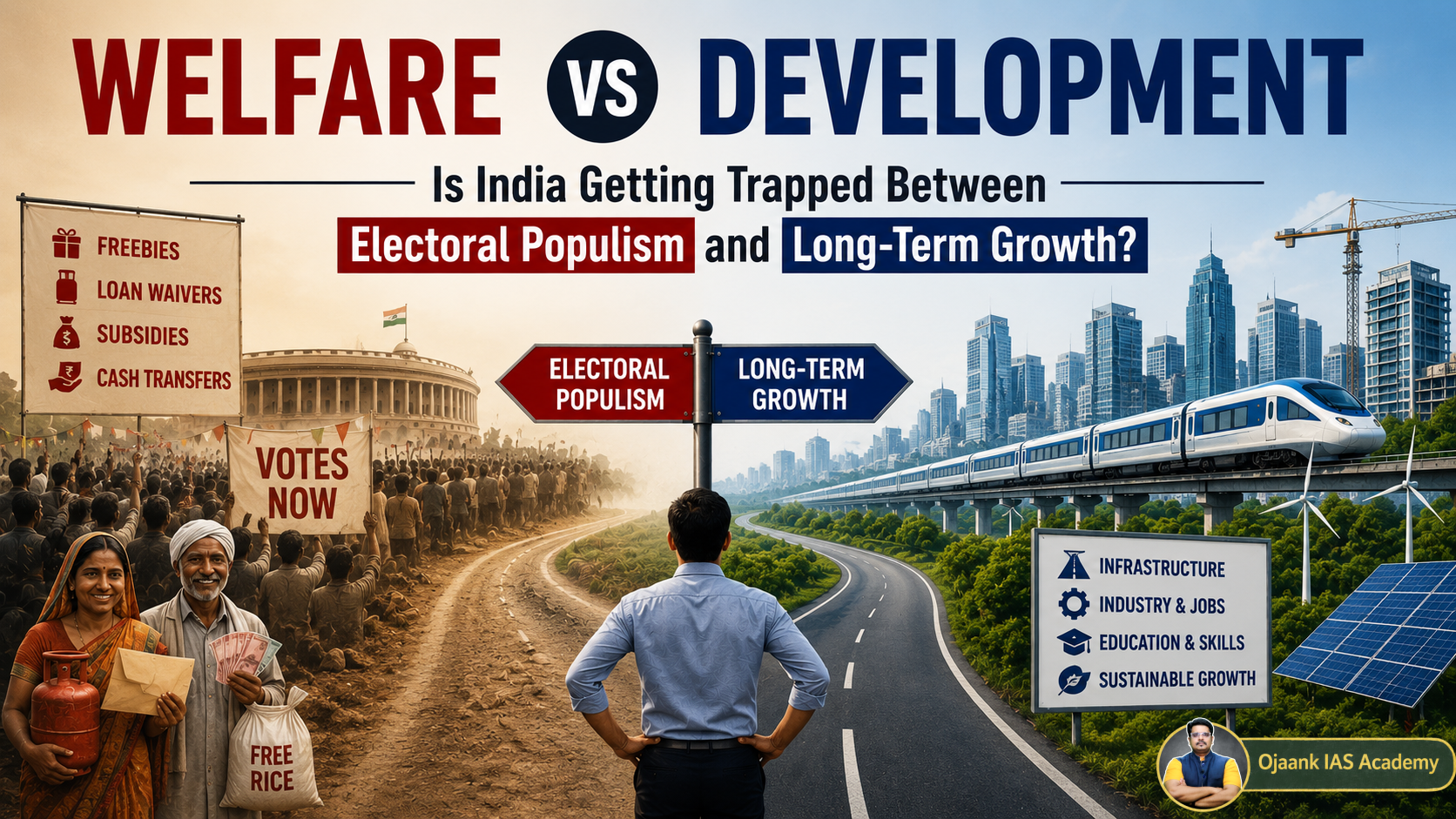
The debate around “welfare versus development” is not new in Indian politics, but in recent years it has become far sharper and more politically significant. Electoral promises such as free electricity, cash transfers, subsidized gas cylinders, and welfare handouts are expanding rapidly across states. At the same time, governments are aggressively investing in highways, semiconductor manufacturing, railways, digital infrastructure, and industrial expansion. The central question is whether India can sustainably pursue both paths together.
The real issue is not simply “freebies versus development.” It is a larger debate about the model of governance India wants to follow. On one side lies immediate social protection for vulnerable groups; on the other lies long-term economic transformation through productivity and institutional capacity building. Excessive focus on short-term relief can weaken development momentum, while growth without social security can deepen inequality and social instability.
Why This Debate Matters Right Now
- Competitive welfare promises are increasingly dominating state and national elections.
- Rising public debt and Fiscal Deficit concerns are putting pressure on state finances.
- India’s ambition to become a $5 trillion economy requires sustained capital investment.
What Do Welfare and Development Actually Mean?
Welfare refers to government measures aimed at providing immediate social support and redistribution. These include subsidies, food security schemes, pensions, healthcare assistance, and direct cash transfers. The objective is to ensure minimum economic security for vulnerable populations.
Development, however, goes far beyond GDP growth. It includes infrastructure expansion, institutional strengthening, education, healthcare, employment generation, technological progress, and productivity enhancement. Economist Amartya Sen’s Capability Approach defines development as the expansion of people’s freedoms and capabilities rather than merely rising income levels.
From Relief to Capability: How the System Works
Welfare and development are often treated as opposites, but in reality they are deeply interconnected.
For example:
Food support to poor families → household stability → children continue education → improved human capital → higher long-term productivity
This shows that well-designed welfare policies can become the foundation of development itself. The problem emerges when welfare schemes are designed primarily for electoral gains without linking them to productivity, education, or capacity-building.
Why Welfare Populism Works So Well in Electoral Politics
Development projects usually take years to produce visible outcomes. Welfare benefits, however, deliver immediate and tangible results. This makes them politically attractive.
The political mechanism often works like this:
Immediate benefit → voter satisfaction → political support → competitive populism
As a result, governments may prioritize short-term electoral benefits over structural reforms such as education quality, judicial reforms, manufacturing competitiveness, or administrative efficiency. Over time, democratic discourse itself shifts from long-term governance outcomes to immediate consumption benefits.
The Economic Challenge: When Subsidies Begin to Crowd Out Investment
India imports nearly 85% of its crude oil requirements. In such a situation, expanding subsidies and welfare spending without corresponding revenue growth can increase the Fiscal Deficit.
Fiscal Deficit refers to the gap between government expenditure and total revenue.
Its economic impact follows a chain:
Fiscal deficit rises → government borrowing increases → interest burden rises → fewer resources remain for productive investment
This means excessive revenue expenditure can reduce the government’s ability to invest in roads, railways, research, education, healthcare, and industrial infrastructure. Economists therefore emphasize balanced expenditure management.
Does Welfare Create Social Dependency?
This remains one of the most contested questions in policy debates.
Critics argue that excessive unconditional welfare may weaken work incentives and productivity. If welfare schemes are not linked to education, employment, or skill development, long-term dependency on the state may increase.
However, India still faces widespread poverty, malnutrition, informal employment, and regional inequality. In such conditions, removing social protection entirely could worsen social vulnerability and inequality.
The real policy question is not whether welfare should exist, but whether welfare should remain consumption-driven or become capability-driven.
How Technology Is Transforming Welfare Delivery
India’s DBT (Direct Benefit Transfer) and Aadhaar-based governance systems have significantly changed welfare delivery mechanisms.
Earlier:
Multiple intermediaries → higher leakages → reduced benefits reaching citizens
Now:
Digital identity → direct bank transfers → transparency increases → corruption declines
Digital governance has demonstrated that technology can make welfare systems more efficient and accountable. The JAM Trinity (Jan Dhan-Aadhaar-Mobile) model is often viewed globally as a major administrative innovation.
What Does the Constitution Say?
India’s constitutional framework strongly supports the idea of a welfare state through the Directive Principles of State Policy (DPSP).
- Article 38: Promotion of social, economic, and political justice
- Article 39: Equitable distribution of resources
- Article 41: Right to work, education, and public assistance
Additionally, Article 21’s interpretation of the Right to Life includes dignity and basic necessities. Therefore, welfare measures carry strong constitutional legitimacy. However, fiscal discipline and transparent governance are equally important democratic responsibilities.
What Can India Learn from Global Models?
Nordic countries have managed to combine strong welfare systems with high productivity and institutional efficiency. Their welfare systems are supported by high taxation and strong public services.
On the other hand, several developing economies that relied excessively on populist spending eventually faced debt crises and macroeconomic instability. This is why institutions like the IMF and World Bank advocate targeted subsidies rather than universal populist expansion.
For India, the key lesson is clear:
Welfare must be linked to human capital formation.
Investment in nutrition, education, healthcare, and skills should be treated not merely as expenditure, but as long-term economic investment.
What Does This Mean for India?
India is simultaneously dealing with:
- Employment generation challenges
- Regional disparities
- Rural distress
- Rapid urbanization
- Climate pressures
- Global economic uncertainty
In this environment, infrastructure-led growth alone may not be sufficient. At the same time, excessive dependence on welfare transfers cannot build long-term economic competitiveness.
India therefore needs a “security plus productivity” model:
Basic social protection + quality education + healthcare + employment-oriented growth
What If the Policy Path Had Been Different?
If India had followed only a market-driven growth model after 1991 without significant welfare expansion, economic growth may have accelerated faster, but social inequality could have widened sharply.
Conversely, if the policy framework had relied primarily on subsidies and transfers, India’s industrial competitiveness and capital formation could have weakened substantially.
Both extremes carry serious risks.
What Could Happen Next?
- Best Case: India successfully integrates welfare with human capital and productivity growth.
- Most Likely: Competitive welfare politics continue while infrastructure investment remains a central national priority.
- Worst Case: Excessive populist spending pushes states into deeper debt and fiscal stress.
Conclusion
India’s real challenge is not choosing between welfare and development but designing a sustainable balance between the two. In a democracy, social protection is essential. But without long-term economic growth and institutional capacity, welfare itself becomes fiscally unsustainable.
Ultimately, strong nations are built not only by providing relief but also by creating opportunity.
FAQs
Q1. What is the difference between welfare and development?
Welfare focuses on immediate social relief and redistribution, while development emphasizes long-term economic growth, productivity, and institutional capacity.
Q2. Are welfare schemes always harmful to the economy?
No. Welfare linked to education, healthcare, nutrition, and skills can strengthen human capital and support long-term growth.
Q3. Why is Fiscal Deficit important?
It measures the gap between government expenditure and revenue. Excessive deficits can increase debt and reduce future investment capacity.
Q4. How has DBT changed welfare delivery in India?
Direct Benefit Transfer has reduced leakages and corruption by transferring benefits directly into beneficiaries’ bank accounts.
Q5. Can India adopt the Nordic welfare model?
Not entirely, due to India’s scale and economic structure. However, India can adopt lessons related to human capital investment and efficient welfare delivery.
Click here for more blogs:
https://www.ojaank.com/