Xi Jinping’s Taiwan Warning to Trump: Is the World Moving Toward a US-China Conflict?
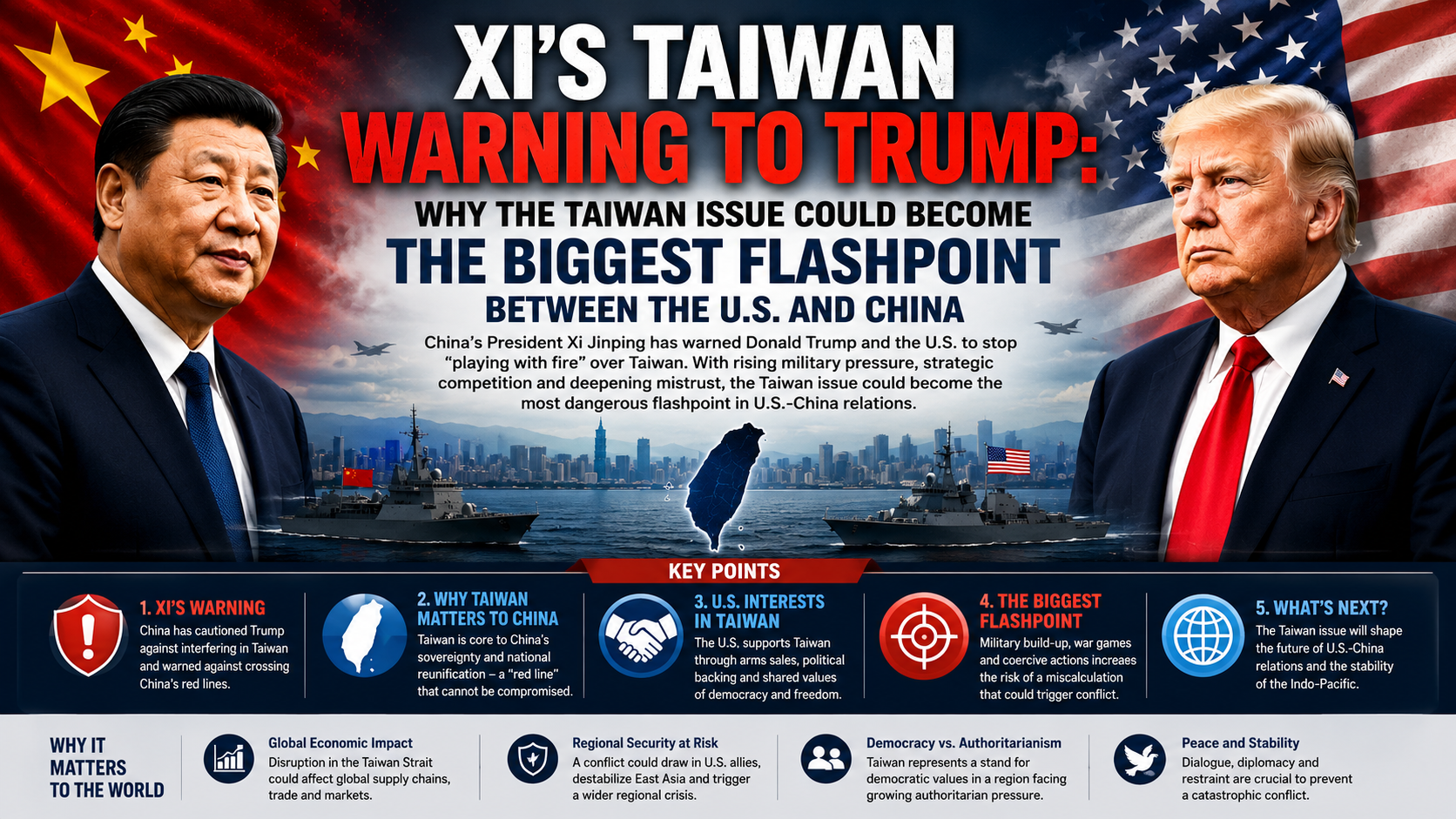
Xi’s Taiwan Warning to Trump: Why the Taiwan Issue Could Become the Biggest Flashpoint Between the U.S. and China
The Taiwan issue has once again emerged as the most dangerous fault line in global geopolitics after Chinese President Xi Jinping warned U.S. President Donald Trump that mishandling Taiwan could push both countries toward “conflict.” The warning came during a high-stakes U.S.-China summit in Beijing, where trade tensions, artificial intelligence, Iran, and Indo-Pacific security were already dominating discussions. (Reuters)
This statement is not merely diplomatic rhetoric. It reflects the growing strategic competition between the world’s two largest powers and highlights how Taiwan has become central to global security, technology supply chains, military strategy, and the future balance of power in Asia.
Why is Taiwan So Important?
China’s Perspective
China considers Taiwan an inseparable part of its territory under the “One China Principle.” Beijing views any foreign support for Taiwan as interference in its internal affairs.
For China:
-
Taiwan is linked to territorial integrity and national sovereignty
-
Reunification is considered a historic mission
-
Foreign military support to Taiwan is viewed as a direct strategic threat
Chinese state media described Taiwan as the “most important issue” in China-U.S. relations. Xi Jinping reportedly warned that mishandling the issue could create a “highly perilous situation.” (The Guardian)
America’s Perspective
The United States officially follows the “One China Policy,” but it also maintains strong unofficial relations with Taiwan through:
-
Arms sales
-
Strategic cooperation
-
Economic partnerships
-
Security commitments
Under the Taiwan Relations Act, the U.S. helps Taiwan maintain self-defense capabilities.
For Washington:
-
Taiwan is crucial for Indo-Pacific security
-
It acts as a strategic counterbalance against China
-
Protecting Taiwan strengthens U.S. credibility among allies like Japan and South Korea
This creates a situation of “strategic ambiguity,” where the U.S. does not clearly state whether it would militarily defend Taiwan during a Chinese attack.
Why the Current Summit Matters
The Trump-Xi summit comes at a time when U.S.-China relations are already strained because of:
-
Trade wars
-
Tariffs
-
Semiconductor competition
-
AI rivalry
-
South China Sea tensions
-
Iran conflict
-
Military competition in the Indo-Pacific
Taiwan has now become the emotional and strategic center of this rivalry. (Wall Street Journal)
The summit also reflects a deeper global concern:
Can the U.S. and China avoid falling into a “Thucydides Trap” — a situation where a rising power and an established power drift toward conflict? Xi Jinping himself referred to this historical idea during the summit. (New York Post)
Why Taiwan is Globally Significant
1. Global Semiconductor Hub
Taiwan is home to Taiwan Semiconductor Manufacturing Company (TSMC), the world’s most advanced semiconductor manufacturer.
These chips are essential for:
-
Smartphones
-
Artificial Intelligence
-
Defense systems
-
Electric vehicles
-
Global digital infrastructure
Any conflict involving Taiwan could disrupt the global technology supply chain and trigger a worldwide economic crisis.
2. Indo-Pacific Security
Taiwan lies strategically between:
-
East China Sea
-
South China Sea
-
Western Pacific Ocean
Control over Taiwan would significantly expand China’s naval reach and alter the military balance in Asia.
This is why:
-
Japan closely monitors Taiwan tensions
-
The U.S. maintains naval presence nearby
-
Indo-Pacific alliances are becoming stronger
3. Symbol of Democratic vs Authoritarian Competition
Taiwan functions as a democratic political system, while China operates under a one-party Communist structure.
For many Western nations, Taiwan represents:
-
Democratic governance
-
Open political systems
-
Liberal international order
For China, foreign support for Taiwan is seen as an attempt to contain China’s rise.
Key Challenges in the Taiwan Issue
Military Escalation Risk
China has increased:
-
Naval exercises
-
Air force incursions
-
Military drills near Taiwan
Meanwhile, the U.S. continues:
-
Arms support
-
Indo-Pacific military partnerships
-
Freedom of navigation operations
This raises the possibility of accidental escalation.
Economic Consequences
A Taiwan conflict could:
-
Disrupt global trade routes
-
Collapse semiconductor supply chains
-
Trigger stock market instability
-
Increase inflation worldwide
Global economies remain deeply interconnected with both China and Taiwan.
Diplomatic Polarization
Countries increasingly face pressure to align either:
-
Closer to the U.S.
or -
Closer to China
This may deepen geopolitical polarization across Asia and beyond.
Impact on India
For India, Taiwan tensions carry both strategic and economic implications.
Strategic Implications
-
China’s growing assertiveness affects India’s security environment
-
Indo-Pacific tensions influence Quad cooperation
-
Maritime security becomes increasingly important
Economic Implications
-
Semiconductor disruptions may affect India’s electronics sector
-
Supply-chain diversification could create opportunities for India
-
India may benefit from companies shifting manufacturing away from China
India continues balancing:
-
Strategic autonomy
-
Relations with the U.S.
-
Border tensions with China
Can Conflict Be Avoided?
Despite rising tensions, both countries understand the enormous cost of direct confrontation.
The summit indicates that:
-
Economic interdependence still matters
-
Diplomatic engagement continues
-
Both sides seek controlled competition rather than open war
However, Taiwan remains the single issue with the highest potential to trigger a future U.S.-China military crisis.
Conclusion
Xi Jinping’s warning to Donald Trump reflects the growing seriousness of the Taiwan issue in global politics. Taiwan is no longer just a regional dispute; it has become a central question involving the following:
-
Global power competition
-
Technology dominance
-
Economic stability
-
Indo-Pacific security
-
International order
As U.S.-China rivalry intensifies, Taiwan will continue shaping the future of global geopolitics. The challenge before both nations is whether they can manage strategic competition peacefully or allow mistrust and nationalism to push the world toward confrontation. (Reuters)